
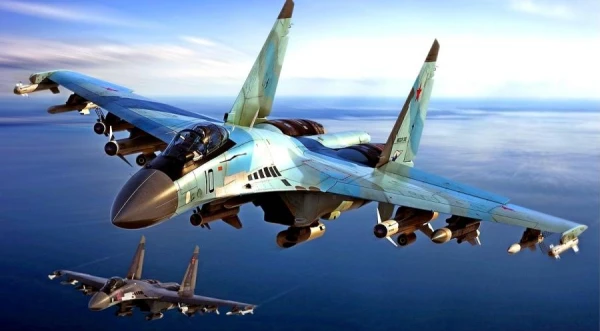
The West is convinced that they will surely defeat the Russian Air Forces, especially since Ukraine is capable of preventing Russian aircraft from entering its airspace.
The Russian aviation has become a more serious threat to NATO during the war in Ukraine; however, the West mistakenly considers it a colossus on clay feet. This is stated by military analyst Justin Bronk in his analytical report on the website of the British Royal United Services Institute (RUSI).
Why NATO Believes Russian Aviation is Weak
NATO is convinced of the weakness of the Russian Aerospace Forces (VKS) due to their inability to achieve air superiority over Ukraine. In the first months of the war, Russia suffered heavy losses in aircraft: about 130 destroyed or severely damaged planes, counting only those cases that were captured in photos and videos.
The most lost aircraft were Su-25SM and Su-34M (about 40 units of each type). These losses were particularly severe for the Su-34 fleet, of which there were only about 130 units in Russia at the beginning of the war.
"The inability of the VKS to establish air superiority over Ukraine, as well as significant losses of aircraft, weapons, and air defense systems that they have suffered in the conflict so far, have prompted many politicians and military observers to significantly downgrade the VKS's rating as a potential threat to European NATO member states," writes Bronk.
Why NATO is Wrong About the Weakness of Russian Aviation
The analyst is convinced that although the losses of aircraft were significant, they are not critical. For example, the loss of a large number of Su-25 and Su-24, in Bronk's opinion, does not matter at all, as these are outdated aircraft that Russia would not have used in a hypothetical conflict against NATO anyway.
As for the more modern aircraft, Russia has fully compensated for the losses of the initial stage of the war and even exceeded the size of the fleet it had then.
For instance, regarding the aforementioned Su-34. At the beginning of the war, Russia had about 130 of them and lost 40. However, in 2022, the Russian army received 8 new aircraft of this type, in 2023 – another 11, in 2024 – another 12-14, and in 2025 – up to 11 more. Thus, during the war, the VKS received about 40 new aircraft of this type, and likely more.
The number of Su-35S increased from 90 aircraft at the end of 2020 to 135-140 by the end of 2025. The number of MiG-31 increased from 110 to 125-130. The number of Su-30 slightly decreased – from 150 to 140-145. Additionally, the VKS acquired 20 Su-57 compared to 1 at the end of 2020.
Overall, if in 2020 Russia had 466 operational fighters of various types, by the end of 2025, there will be 545-560 aircraft.
Equally important, during the war, hundreds, if not thousands, of Russian pilots gained real combat experience in modern high-intensity warfare, which they did not have before and which is lacking for most pilots in NATO countries.
Moreover, both the pilots themselves and their command learned to interact more effectively with ground air defense systems and ground forces.
"In any war against NATO forces, the VKS would have faced difficulties in using effective firepower on the battlefield on a large scale due to a lack of weapon options, insufficient targeting modules, and poor training. This is not the case now," notes Bronk.
Russia's War Against NATO: Latest News
As reported by UNIAN, Colonel Valery Vishnevsky, senior representative of Ukraine at the NATO-Ukraine Joint Analytical Training Center, stated that in the event of a war with Russia, NATO countries could suffer even greater losses than Ukraine.
According to him, the modern battlefield is completely saturated with drones that perform reconnaissance and strike tasks. Because of this, the evacuation of the wounded and the provision of medical assistance in the critical first 60 minutes after injury often become nearly impossible. Ukrainian military personnel have to wait for bad weather or low visibility to evacuate the wounded from the combat zone.
Vishnevsky believes that NATO will face the same problems in a potential conflict with Russia, but the scale of destruction and losses could be significantly greater.








Leave a comment