
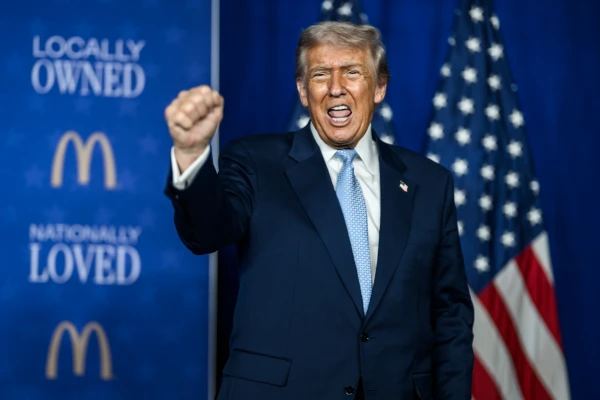
During the operation that stunned observers worldwide, U.S. military forces arrested the President of Venezuela and his wife in Caracas and transported them to New York, where they will face criminal charges.
First Maduro, then Venezuela: after the unexpected arrest of President Nicolás Maduro and his wife Cilia Flores, involving several units of the U.S. armed forces, President Donald Trump announced that Washington would temporarily take control of the South American country.
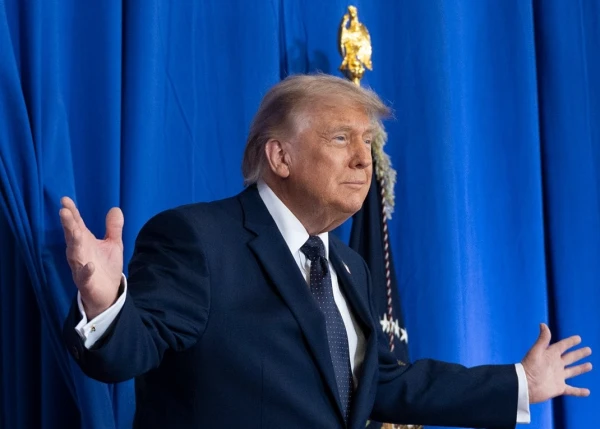
"We will manage the country until we can effect a safe, proper, and reasonable transition," Trump said Saturday at a press conference from his Mar-a-Lago resort in Florida.
"We cannot risk having someone else take over Venezuela who will not care for the good of the Venezuelan people."
Trump added that the U.S. would manage Venezuela with a "group" and "appoint different people" to be responsible - pointing to Secretary of State Marco Rubio, Defense Secretary Pete Hegseth, and Chairman of the Joint Chiefs of Staff General Dan Cain behind him.
Despite repeated questions from reporters, Trump remained tight-lipped.
At one point, he stated that Venezuelan Vice President Delcy Rodríguez "just took the oath" as Maduro's successor and said she was "ready to do whatever we deem necessary to make Venezuela great again."
However, the Venezuelan government did not announce that Rodríguez had taken the oath.
Trump's statement marks a significant escalation of U.S. intervention after months of speculation about whether Washington would invade the country and what the American administration's plans for a transitional period would look like. "We are not afraid of 'boots on the ground,'" Trump said.
"Our very large U.S. oil companies, the largest in the world, will enter the country, spend billions of dollars, fix the severely damaged infrastructure, oil infrastructure, and start making money for the country," he added.
"And we are ready to conduct a second and much larger attack if necessary."
At the same press conference, U.S. Secretary of State Marco Rubio dismissed the notion that the operation in Venezuela required Congressional approval.
Instead, Rubio called it a law enforcement operation supported by the U.S. armed forces, for which Congressional involvement is not required.
"The operation was not a mission that required notifying Congress," Rubio said.
"Nicolás Maduro was indicted in the U.S. in 2020. He is not the legitimate president of Venezuela," Rubio continued.
"He is a fugitive from American justice with a $50 million bounty. I think now we save $50 million," he added.
In response, Trump suggested that the administration did not inform Congress because the plans for the operation could have leaked.
Political opposition in Washington was quick to criticize Trump's actions in Venezuela, without justifying Maduro.
"If the United States claims its right to use military force to invade and capture foreign leaders whom they accuse of criminal behavior, then what prevents China from claiming similar powers regarding the leadership of Taiwan? What prevents Vladimir Putin from claiming similar grounds for abducting the president of Ukraine?" said Democratic Senator Mark Warner, vice chairman of the Senate Intelligence Committee.
"Once this line is crossed, the rules that restrain global chaos will begin to crumble, and authoritarian regimes will be the first to take advantage of it," he added.
"The hypocrisy underlying this decision is particularly evident," Warner continued, comparing the operation in Venezuela to Trump pardoning former Honduran President Juan Orlando Hernández, who was convicted by an American court on serious drug trafficking charges.
"Yet now the administration claims that such accusations justify the use of military force against another sovereign state. It cannot be credibly argued that drug trafficking allegations require an invasion in one case and yet grant a pardon in another."
Trump was supported by Republican representatives in Congress. Senator Roger Wicker, chairman of the Senate Armed Services Committee, issued a brief statement thanking Trump "for the order to successfully carry out the mission" of arresting Maduro and holding him accountable in the U.S.
"This arrest culminated months of efforts by the Trump administration to dismantle the drug-terrorist organizations that Maduro oversaw," Wicker added.
"Now the Venezuelan people must act quickly to restore their country to a path of peace and prosperity, which will benefit all its neighbors," Wicker said.
The operation in Venezuela could mark the beginning of a period of enormous change in the country, said Daniel DePetris, a fellow at the Defense Priorities think tank, in a statement sent via email. "Whether these changes will be positive or negative in the long term remains unclear," he added.
"A split in the Venezuelan armed forces, the expansion of criminal gangs in the country, civil war, and the rise of an even more brutal autocrat are all possible scenarios. None of them bode well for regional stability or U.S. interests in the sphere of influence," DePetris said.
The Trump administration's justifications for pressuring Maduro have shifted multiple times over the past few months.
They ranged from combating drug trafficking and reclaiming oil resources that Venezuela allegedly stole from the U.S. to overthrowing an authoritarian government in the name of democracy.
In each case, Venezuela was described as a direct threat to U.S. security in the Western Hemisphere.
"But that is too great a credit to the Maduro regime. In reality, Venezuela is a failed state, whose economy has rapidly contracted over the past decade," DePetris said.





Leave a comment