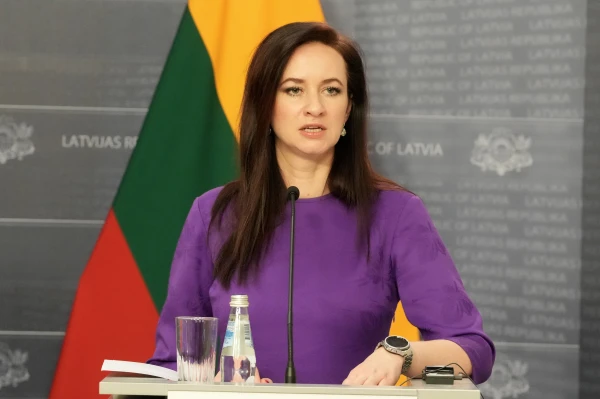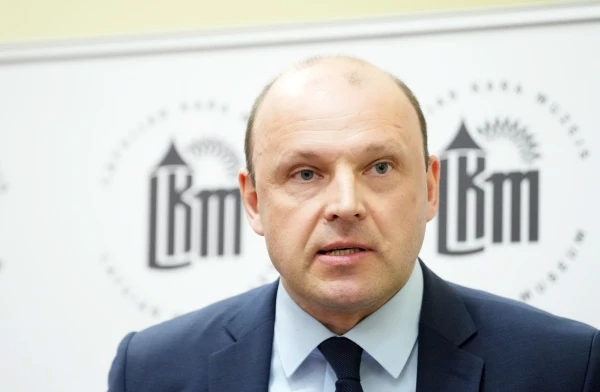
The likelihood of achieving an end to the war in Ukraine in 2026 is higher than it was this year, said Tom Rostoks, director of the Center for Security and Strategic Studies at the National Defense Academy, to the LETA agency.
He emphasized that it cannot be confidently stated that the war will end in 2026; however, the possibilities for this are significantly greater than in the current year, and there are several reasons for this. The expert explained that international negotiations to end the war take time, as they are complicated not only due to the radically differing positions of the warring parties but also because it is necessary to find solutions to complex problems during the negotiations.
Rostoks stressed that the parties involved in the conflict are increasingly tired of the war. Furthermore, during 2026, problems in the Russian economy may escalate, which could increase pressure on the President of Russia to end the war, despite the fact that the goals of the "special military operation" have not been achieved. He added that in the fall of next year, the United States will hold midterm elections, so actions by the U.S. may be influenced by both the twists of the election campaign and the voting results in November.
In response to the question of whether Western policy towards Ukraine could change in the next six months—either through increased or decreased support—the director of the Center for Security and Strategic Studies at the National Defense Academy noted that the "rules of the game" regarding support for Ukraine are currently quite clear and are unlikely to change.
He stated that the U.S. provides Ukraine with intelligence information and sells weapons to Europe, which then transfers them to Ukraine. In turn, European countries almost completely provide military and economic assistance to Ukraine and seek to enhance their own military capabilities and defense industry potential. According to Rostoks, specific nuances of this distribution of roles may change, but not its essence.
When asked at what point the behind-the-scenes pressure from the U.S. in favor of peace could turn into a political factor influencing the decisions of Ukraine and Europe, the expert emphasized that the U.S. has significant influence over the actions of European states and Ukraine. He pointed out that it is essentially the U.S. that is leading the diplomatic process, which gives them significant advantages in relations with European allies and Ukraine. According to Rostoks, an important goal for European countries and Ukraine in 2026 will be to reduce dependence on the U.S., which will provide them with greater independence in decision-making.
Speaking about what will be more important for Russia in the next six months—real progress on the front or creating the impression of such progress—Rostoks emphasized that Russia seeks to achieve real advancement. If this is not possible, then the goal is to create the appearance of progress. He explained that this has both strategic goals, including influencing the international negotiation process to end the war, as well as organizational, selfish motives—the desire of the Russian armed forces to present the desired as reality, as this affects the favor of political leadership, career advancements, and awards.
In November, the U.S. proposed a peace plan that included transferring to Russia control over those parts of the Donetsk and Luhansk regions that it does not yet control. The Donetsk and Luhansk regions, as well as Crimea, would be recognized as de facto territories under Russian control, and a demilitarized zone would be established in Donbas. In the Zaporizhzhia and Kherson regions, which Russia has declared as its territory but does not fully control, the front line would be frozen. Russian troops would have to leave occupied territories in other regions of Ukraine.
In response to the question of which decision Ukraine will find most difficult to make in the next six months in the event of increased external pressure, Rostoks emphasized that the most difficult decisions are related to territorial issues in Donbas. He noted that Ukraine would definitely not want to succumb to pressure at the end of the war and agree to the principle of "territory for peace."
In his opinion, this would create the impression that Ukraine lost the war if it had to make such concessions. Rostoks also believes that this would worsen Ukraine's ability to defend itself against potential Russian aggression in the future. He emphasized that other issues are also important, such as guarantees of security from the U.S. or the West.
"It would be bad if Ukraine had to concede and agree to vague security guarantees in case Russia resumes aggression in the future," the director of the Center for Security and Strategic Studies at the National Defense Academy emphasized.
It was previously reported that in December, the U.S. proposed a new format for negotiations with Ukraine and Russia; however, no agreements on peace or a ceasefire were reached. The desire of Russia to maintain or expand control over occupied territories and Ukraine's demand for clear security guarantees, which Kyiv considers a prerequisite for any long-term peace, remain contentious issues.