
Economic security is needed, and this is not always achieved solely through a tough stance.
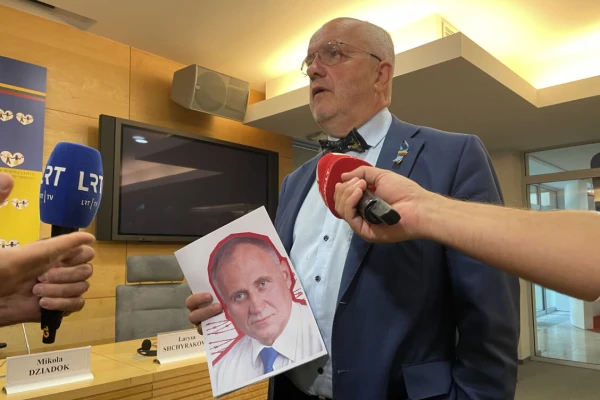
The Speaker of the Seimas of Lithuania, Juozas Olekas (70 years old, born in Krasnoyarsk Krai, Russia), announced possible changes in relations with Belarus.
"We hope that first all political prisoners will be released, that our detained transport will return, and that is why we are negotiating. Primarily, we are negotiating at the technical level directly with Belarus, and at the political level — through our allies," said the head of parliament.
When asked whether Lithuania should change its policy towards Belarus in light of the fact that the U.S. is "softening its stance" towards it — Washington lifted sanctions on potash, and Minsk released "many political prisoners," Olekas replied that a tough position of restrictive measures and pressure yields certain results, but not a final one.
According to him, Lithuania is discussing with allies at the NATO and European Union levels how to achieve the best possible outcome so that Alexander Lukashenko's regime "does not feel like a winner, so that neither Lithuania nor democratic European states lose, and political prisoners can gain their freedom."
In the context of comments regarding the opinion of the President's chief advisor on national security, Deividas Matulionis, that the resumption of potash transit could be linked to the deployment of new U.S. troops in Lithuania, Olekas stated that the Seimas postponed the adoption of a resolution on Belarus's "hybrid attack." Thus, he said, it was decided to "find opportunities to discuss various options." The Speaker of Parliament emphasized that Lithuania "needs security, economic security, and this is not always achieved solely through a tough stance, but also through diplomatic means."
Lithuanian Foreign Minister Kęstutis Budrys stated that Vilnius would agree to send an ambassador with special assignments to Belarus for negotiations. According to him, such a proposal has been repeatedly sent by the Lithuanian side to Belarus both verbally and in writing. The spokesperson for the Belarusian Foreign Ministry, Ruslan Varankov, stated that no official proposal or request for organizing a meeting from Lithuania through diplomatic channels has been received.
After negotiations in Minsk, 123 political prisoners were released and taken out of the country by U.S. Special Envoy for Belarus John Cole and Alexander Lukashenko. Most of them are currently in Ukraine. The American diplomat stated that the U.S., at the direction of President Donald Trump, is lifting sanctions on Belarusian potash fertilizers.
Earlier, the U.S. Department of the Treasury's Office of Foreign Assets Control (OFAC) published a general license allowing transactions with OAO "Belaruskaliy" and OAO "Belarusian Potash Company" (BPC).
The license clarifies the rules regarding sanctions against Belarus (Belarus Sanctions Regulations, BSR) and permits transactions involving BPC, its Ukrainian subsidiary LLC "Agrorozkvyt," "Belaruskaliy," as well as any organization in which "one or more of the above-mentioned persons own, directly or indirectly, individually or jointly, a stake of 50% or more."
At the same time, the license does not permit the unblocking of any property previously blocked and "any transactions prohibited by BSR, including transactions related to the property or shares in the property of any person blocked under BSR, except for the blocked legal entities described in this general license, unless separately authorized."
It is expected that in spring 2026, the European Union will decide on the extension of its own sanctions regarding Belarusian fertilizers.



Leave a comment