
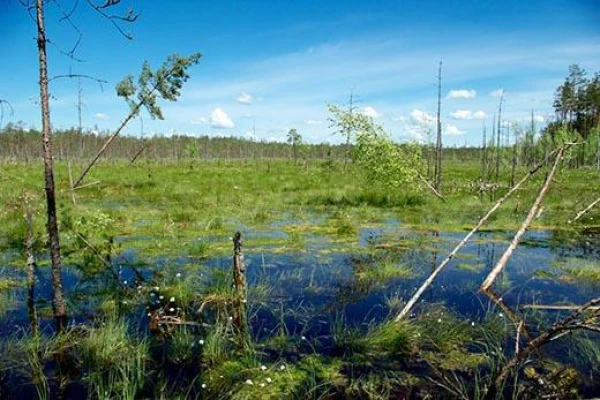
Poland, Finland, and Lithuania are restoring swamps. This was previously required by the EU's "climate agenda," and now — by the defense agenda, as military experts believe that tanks from Russia cannot pass through such terrain.
According to European military estimates, it was the swamps that prevented the Russian army from "taking Kyiv in three days" in early 2022, writes Grani.lv. At that time, Ukrainians blew up the dam of the Irpin River north of their capital, turning a vast area into a quagmire and striking stuck Russian tanks with American Javelins.
This experience is now being adopted in the EU. Lithuania, Poland, and Finland are launching peatland restoration projects to simultaneously combine defense and climate policy goals: so to speak, two in one.
Wetlands occupy almost one-tenth of Lithuania's territory, although some of them have been irretrievably lost. According to the Lithuanian National Radio and Television, about 10 million euros will be allocated for pilot peatland restoration projects in 2026, coordinated with the Ministry of Defense. Starting next year, it is planned to restore about 40,000 hectares of peatlands.
By the way, Lithuania has learned from bitter experience that swamps can serve as a dangerous trap for heavy military equipment — when in March of this year, during military exercises at the Pabrade training ground, a 63-ton M88 Hercules armored vehicle with four American soldiers sank. A complex six-day operation involving specialists from the USA, Lithuania, and Poland was required to lift them from the swamp.
The publication Defence 24 notes that most of the peatlands in the European Union are located along the NATO border with Russia and Belarus, stretching from the Arctic territories of Finland to the so-called Suwalki Corridor (a narrow strip in southwestern Lithuania and northeastern Poland that separates Belarus from the Russian exclave of Kaliningrad).
Finland has already begun a pilot program for the restoration of border wetlands. Poland is also engaged in this, having allocated 2.37 billion euros for peatland restoration as part of its defense program.
The publication Politico emphasizes that the restoration of swamps and wetlands along NATO's eastern flank is a wonderful and relatively inexpensive way to combine "two European priorities that are increasingly competing for attention and funding: defense and climate." Swamps store huge amounts of CO₂, which, as a result of drainage, enter the atmosphere, contributing to global warming. Meanwhile, more than half of Europe's wetlands have been destroyed or converted into agricultural land. This is why the EU's climate goal is to restore 30% of degraded peatlands by 2030 and 50% by 2050.
However, countries have previously allocated funds for this with reluctance. Now, when swamps can be drained under defense budgets, things are moving much more cheerfully. As Finnish MP Pauli Alto-Setälä noted in an interview with The Telegraph: "There are not many things that environmental activists and defense representatives agree on, but here we find a great common denominator."
However, not all EU countries view this idea enthusiastically. For example, in Germany, where more than 90 percent of peatlands have already been drained, the army's reaction is restrained. A representative of the Bundeswehr's Infrastructure and Environment Service stated that "the re-flooding of wetlands can be both beneficial and harmful to NATO operations themselves." After all, in the event of a Russian attack, German troops would have to urgently deploy through their country to the eastern theater of operations, and swamps would severely restrict the movement of military equipment.
Moreover, swamps do not protect against the main weapon of the 21st century — missiles and drones. However, their restoration would significantly impact the agricultural sector. It would greatly reduce the area of arable land and leave many farmers unemployed.
Thus, this exotic defense recipe is not suitable for all EU countries. But Poland, Lithuania, and Finland are confident that it is very useful for them and are ready to rewet to enhance their country's combat readiness.








Leave a comment