
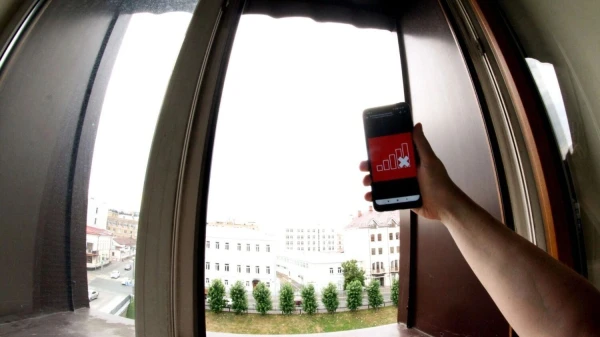
For people in the provinces, the window to the big world has closed.
For six months, Russia has been living in a state of internet outages. Mobile internet disruptions are accompanied by issues with wired connections, the blocking of WhatsApp and Telegram, and in some regions, a complete lack of mobile service. The country is undergoing a defragmentation before the eyes of its citizens.
Just a few years ago, Russian authorities were proud of the pace of internet development in the country, outpacing the USA and Europe. Slogans like "Digital Breakthrough" were heard, and the government reported annually on hundreds of remote settlements gaining access to the global network. Foreigners were amazed by the quality and scale of domestic online services that made life easier for Russians. But everything changed literally in six months.
"The Window to the World Has Closed"
On a street in Ulan-Ude, far beyond Baikal, a girl about 20 years old walks by. She has a mobile phone in her hands. The girl says:
— Why should I live here if there’s no internet?
This is a video story online about the shutdowns.
The regional publication "Our City" from Tyumen asks: can anyone say who has had no connection for a week?
"No connection" is not a slip of the tongue. Life under the "white lists" is happening in a reduced format and looks like this:
— "Ozon" works, but I can’t pay for anything. My neighbor and I tried to buy food for our dogs today. "Sberbank Online" loads, but payments don’t go through. Only "VK Video" with old detective shows and email works. It’s impossible to read the news, checking the weather is an unavailable pleasure. Even "Sber Pharmacy," where you can order medicines, is down. It’s just crazy, — describes her life in the Kaluga region, Svetlana.
IT experts interviewed by "Novye Izvestia" say that the country has been living like this for several months. The new reality has just reached the center of Russia.
For people in the provinces, the window to the big world has closed. Previously, the internet leveled the living conditions in megacities and villages. Now, young people see no reason to stay in their small homeland. Instead of a window, they choose a door.
In Israel, whose army has been at war for two years, the internet was not turned off for a single day, say our former compatriots living in the Promised Land. They managed with a GPS shutdown. Residents were continuously informed about the start of attacks, the need to go to shelters, and the cancellation of air raid alerts.
Alongside the threat of drones, the state is addressing other issues, believes political science doctor Yuli Nisnevich:
— The idea of cutting Russian users off from foreign propaganda may have some sense, but it seems to me that in the provinces, people are not watching "foreign internets" anyway. Of course, it’s easier to turn off the switch. Residents of villages, settlements, and dachas now live as they did in the USSR. There’s no phone, banking apps can’t be used, telemedicine doesn’t work, and taxis can’t be called.
The "white lists," intended to make life easier for people, evoke a sense of déjà vu even among the most loyal and understanding citizens. War correspondent Alexey Zhivov encountered "CheburNet" in Simferopol and described his strong impressions in his TG "Zhivov Z":
"Previously, LTE was completely turned off. Now LTE kind of works, but only certain sites like 'Yandex', 'Mail', and news on 'Zen' open. 'Telegram' is completely blocked. Nothing loads. The best air defense is the blocking of 'Telegram', everyone knows that."
Wired internet is still functioning, although not everywhere and not always. In the Medynsky district of the Kaluga region, laying fiber optic cables in villages is expensive and also takes a long time.
Wired Internet: Was 800 Rubles, Will Be 5000
Wired internet remains the only way that connects the province to the center. Demand for it has increased tenfold. Its advantages, besides a more or less stable connection, are relatively low subscription fees. But this will soon change if the Federal Antimonopoly Service does not intervene.
For a year and a half, wired communication operators have been battling the monopolist "Rosseti," which rents them poles for fiber optic cables. For the internet to reach consumers, the fiber optic cable must be brought to their homes. Previously, "Rosseti" charged providers a fixed fee for a suspension on one pole. Now the monopolist has decided to change the rules and requires separate payments for each cable, each joint, and the box on which the cable is mounted.
For consumers, the price will increase significantly, says provider Konstantin from the Moscow region:
— If a subscriber paid 800 rubles and that money did not include the cost of renting "Rosseti" infrastructure, now about 450 rubles is purely the cost per subscriber, the minimum cost. The maximum cost will be 30 poles multiplied by 97 rubles — that’s almost three thousand. But that’s unrealistic because no one will pay 5000 rubles a month for internet.
"The Elderly Won’t Complain, but the Young Will All Leave"
The shutdown of the internet and mobile communication will inevitably affect the Russian hinterland. In cities, especially large ones, there is wired internet, and there are Wi-Fi hotspots. In villages, there is nothing but mobile internet.
The outflow of residents from villages, even without internet restrictions, is a persistent trend. In the five years following the All-Russian Census of 2020, the rural population decreased by 804,000 people, which is three times the decline in urban areas. Now, the new obstacle is the network disconnection from the country and the world. Young people will flee to cities even faster.
Yuli Nisnevich warns that the new fragmentation in the country will have far-reaching consequences. Communication and transport are among the main factors of quality of life. Due to the size of the country, they play a special role.
— It’s not very clear what will happen to schools that have switched to communicating with parents via the internet, using electronic diaries, and so on. After all, the internet was specifically brought to rural areas where distances are very large. So everything will affect the quality of life. The quality of education, undoubtedly. You cannot fragment what has already been united, — believes Yuli Nisnevich.
For now, the long-standing "unifier" of the Russian state — television — is "strengthening." For the first time in five years, television coverage did not decline, as it had since 2020. This summer, it grew to 59% among the population aged four and older and exceeded the figures of 2024. The overall rating, which takes into account the number of viewers watching television programs at any given time, has also stopped falling.









Leave a comment