
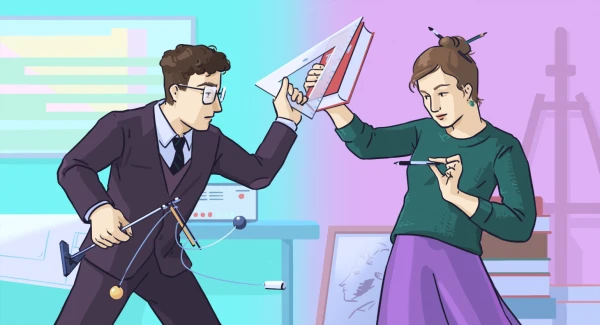
We have all heard the phrase "Mathematics is not for me — I am a humanist." Since school, we are divided into "technicians" and "humanists," as if a person's brain is pre-programmed to love formulas or poetry. But is this really the case? Modern research shows that our abilities are flexible and can be trained, and stereotypes and environment influence who we consider ourselves to be.
Where the Division Between Technicians and Humanities Comes From
The idea of dividing people by types of thinking originated in the 19th century when scientists attempted to classify intelligence. For example, phrenology claimed that abilities depend on the shape of the skull — today this is recognized as pseudoscience.
A real boom occurred in the 1960s with the research of neurobiologist Roger Sperry, who studied patients with epilepsy whose corpus callosum had been severed. He noticed that the left hemisphere was better at speech and logic, while the right was better at recognizing patterns and emotions. These observations gave rise to the myth of "left-brained technicians" and "right-brained humanists."
The problem is that Sperry never claimed that the hemispheres work in isolation, and the studies concerned sick individuals, not healthy ones. Nevertheless, the myth took root.
How the Brain Hemispheres Actually Work
Modern neurobiology refutes the rigid division. The hemispheres have specialization but work together. The left is responsible for grammar and speech structure, while the right is responsible for intonation and emotional coloring. When reading a book, both hemispheres are synchronized: the left decodes letters, while the right helps capture emotions.
MRI studies of 1,000 people have shown that both mathematics and creativity engage dozens of areas in both hemispheres. For example, solving an equation activates not only the "logical" zones of the left hemisphere but also the visual-spatial zones of the right.
What Determines a Tendency Towards Mathematics or Creativity
Despite the myths about the hemispheres, tendencies are shaped by:
Environment and stereotypes. A child's brain is like a garden: what grows in it depends on the soil and care. Support, absence of stereotypes, and positive feedback develop both creative and analytical abilities.
Genetics. For example, variations in the ROBO1 gene affect the volume of gray matter in the right parietal cortex, but genes set potential, not a sentence. Training and education can compensate for innate differences.
Can a "Humanist" Become a "Technician"
The brain is plastic. Neuroplasticity allows for the restructuring of neural networks even in adulthood. London taxi drivers, memorizing streets, "exercise" their hippocampus, and later this area may shrink to make way for other skills.
Mistakes are allies of the brain. When a person makes a mistake, neural pathways are activated, forming new connections. Even an adult who considers themselves a humanist can master mathematics or science with regular training.
What’s the Conclusion
Our brain does not divide the world into formulas and metaphors — it is designed to master both. If it seems that mathematics is difficult or creativity is inaccessible, the reason is often in the methods of teaching or stereotypes, not in biology.
Start small: visual puzzles, short texts, comics — games and novelty form new neural connections. The main thing is that you do not have to conform to labels: both technicians and humanists represent potential that can be developed.










Leave a comment