
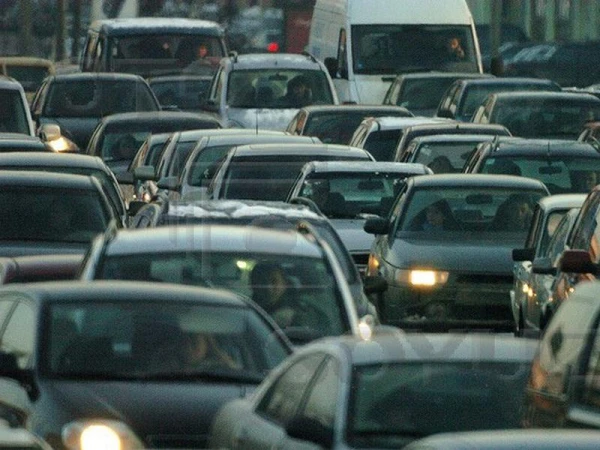
A third of Tallinn's residents (32%) spend at least two hours a week in traffic jams — more than residents of Riga and Vilnius. This is evidenced by the data from the international Friendly City Index study.
In addition to Tallinn, the study from Estonia also included Tartu, Pärnu, Narva, and Kohtla-Järve. According to the results, the situation with traffic jams is best in Pärnu, where just over 5% of residents spend more than two hours in them each week. Following Tallinn in terms of road congestion are Kohtla-Järve, Narva, and Tartu.
Compared to other cities in the region, Estonian cities rank in the middle. The most affected by traffic jams are residents of Romania and Poland — cities in these countries occupy the top 20 spots in the unfortunate ranking.
According to the study, more than a third (34%) of residents in Central and Eastern Europe spend two or more hours in traffic jams each week, which amounts to about one hundred hours of downtime per year. One in fifteen spends at least four hours a week in traffic. A total of 50 cities participated in the survey, and the results clearly show that in many regions, the car-oriented mobility model is no longer sustainable.
One of the key findings of the study is that traffic jams directly shape people's transportation habits. More than half of the region's residents completely avoid peak hours to avoid being stuck in traffic. In Estonia and Latvia, there is a noticeable trend: when necessary, people increasingly choose public transport and micro-mobility options. A similar picture is observed in the Czech Republic and Slovakia.
Due to traffic jams, 38% of respondents choose public transport, 28.5% prefer walking, and 10% opt for bicycles or scooters. To avoid congestion, residents of Estonia most often use public transport — 40% of respondents named it the most convenient solution. At the same time, residents of Latvia prefer walking, while Poles more frequently choose bicycles or scooters.
The social aspect of the study shows that traffic jams affect people not only in terms of time loss but also emotionally. Although only 7.5% of respondents admitted to experiencing constant stress or irritation due to traffic jams, age differences turned out to be significant. The situation affects young people aged 18 to 34 the most: they report that daily traffic jams increase tension and fatigue. Among older individuals, this influence is less pronounced.
The Friendly City Index is an international project aimed at assessing the quality of life and urban development in Central and Eastern Europe based on residents' experiences. The index takes into account factors such as the duration of daily commutes, accessibility of green spaces, and the condition of cycling and pedestrian infrastructure.
The 2025 study was conducted in nine countries: Estonia, Latvia, Lithuania, Poland, the Czech Republic, Slovakia, Ukraine, Croatia, and Romania. A total of 4,500 people participated in the survey.
















Leave a comment