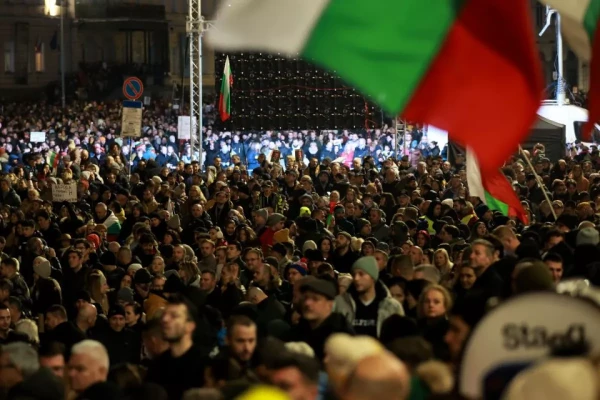
Tens of thousands of people gathered on Wednesday across Bulgaria, demanding the resignation of Prime Minister Rosen Zhelyazkov. Demonstrators accuse the government of widespread corruption. The demonstrations come just weeks before Bulgaria's entry into the eurozone on January 1.
Bulgarian Prime Minister Rosen Zhelyazkov officially announced the resignation of his cabinet on December 11. The decision was made against the backdrop of weeks of mass protests and an upcoming vote of no confidence in parliament.
Reasons for Resignation
Since the end of November, protests against tax policy and rising social contributions have been taking place across the country. Thousands of citizens took to the streets of Sofia, demanding a change of power and a stronger fight against corruption. The day before, protesters in the capital projected slogans such as "Resignation" and "Mafia Out" onto the parliament building.
According to media estimates based on drone footage, the number of demonstrators exceeded 100,000, with some reports indicating that up to 150,000 people gathered in the Bulgarian capital.
Students from Sofia universities joined the rallies, which, according to organizers, surpassed last week's protests that gathered more than 50,000 people.
Other protests took place in more than 25 major cities in Bulgaria, including Plovdiv, Varna, Veliko Tarnovo, and Razgrad.
In Plovdiv, several thousand people gathered in the "Unity" square, waving large Bulgarian flags and holding anti-government placards.
A protest also took place in Burgas, where around 10,000 people gathered in front of the municipality building and presented their demands through sketches and videos projected on a video wall.
Bulgarians abroad also gathered on Wednesday: demonstrations took place in Brussels, London, Berlin, Vienna, Zurich, and New York.
Among the demands are the resignation of the government and improved living and working conditions.
The demonstrations followed last week's rallies sparked by the government's budget proposals for 2026, which included tax increases, higher social security contributions, and increased spending.
Subsequently, the government withdrew the controversial budget plan.
Zhelyazkov emphasized that the decision to resign is related to the "voice of society," which cannot be ignored. According to him, the government ensured macroeconomic stability and income growth but lost the trust of citizens.
Concerns About Oligarchs' Influence
Protesters directed their anger at Delyan Peevski, a Bulgarian politician and oligarch whose party, the Movement for Rights and Freedoms (MRF), supports the minority coalition government.
In June 2021, Peevski was sanctioned by the U.S. under the Global Magnitsky Human Rights Accountability Act for corruption. The U.S. Treasury Department stated that he "regularly engaged in corruption, using influence peddling and bribes to protect himself from public scrutiny and to establish control over key institutions and sectors of Bulgarian society."
The UK also imposed sanctions on Peevski in February 2023.
Previously, Peevski owned the most popular daily newspapers in Bulgaria and controlled a significant portion of the media landscape, after which he sold his media assets following U.S. sanctions.
In 2018, the organization "Reporters Without Borders" stated that Peevski embodies "corruption and collusion between the media, politicians, and oligarchs."
Opponents accuse Peevski of shaping government policy in favor of oligarchic interests. Critics argue that real influence is shared between former Prime Minister Boyko Borissov and Peevski, reinforcing the perception that Peevski wields significant influence over the cabinet.
Borissov has served as Prime Minister of Bulgaria three times since 2009, leading the center-right GERB party. He resigned in February 2013 after nationwide protests over electricity prices and corruption, and his government fell again in 2020-2021 after anti-corruption demonstrations.
Opponents accuse Peevski of shaping government policy in favor of oligarchic interests. Although the MRF is not officially part of the ruling coalition, its votes in parliament are crucial, and those calling for his resignation argue that this allows him to control all decision-making processes in the country.
Vote of No Confidence in the Cabinet
Although the protest was mostly peaceful, 57 people were detained in Sofia. This was reported by Euronews Bulgaria.
According to Sofia police chief Lyubomir Nikolov, aggressive young people were detained in front of the MRF headquarters. The police, who stated that these were provocateurs rather than genuine demonstrators, found 10,000 leva (5,100 euros) on one of the detainees and about 1,500 euros on another.
On Wednesday, the opposition coalition "We Continue the Change - Democratic Bulgaria" called for a vote of no confidence in the government. The vote, already the sixth of its kind, is scheduled for Thursday.
President Rumen Radev wrote on Facebook that the demonstrations on Wednesday effectively serve as a vote of "no confidence in the cabinet."
He urged lawmakers to "listen to the people" and "choose between the dignity of free voting and the shame of dependence" when they vote on Thursday.
On January 1, Bulgaria will become the 21st member of the eurozone, abandoning its national currency: the country will switch from leva to euro.
A survey published in June, commissioned by the Bulgarian Ministry of Finance, showed that 46.8% of citizens oppose the single European currency, while 46.5% support it.
Political Context
Zhelyazkov's cabinet was formed in early 2025 with the support of the GERB, BSP, and ITN parties. However, less than a year later, it faced a crisis of trust. The opposition, including the coalition "We Continue the Change - Democratic Bulgaria," initiated a vote of no confidence, accusing the government of failing to implement reforms and ensure transparency.
Consequences for Bulgaria The resignation paves the way for the formation of a new government or early elections. Experts note that the political crisis in Bulgaria reflects broader trends in the region — growing dissatisfaction with tax policy and demands for greater transparency from authorities.
Consequences for the European Union
The resignation of the Bulgarian cabinet is significant not only for the country's internal politics but also for the European Union. Bulgaria is in the process of preparing to join the eurozone, and a change of government could slow this process. Additionally, the crisis intensifies discussions in the EU about the need for stricter anti-corruption mechanisms and financial transparency in member states. Thus, the events in Sofia become part of a broader European agenda concerning trust in institutions and the resilience of democratic systems.