
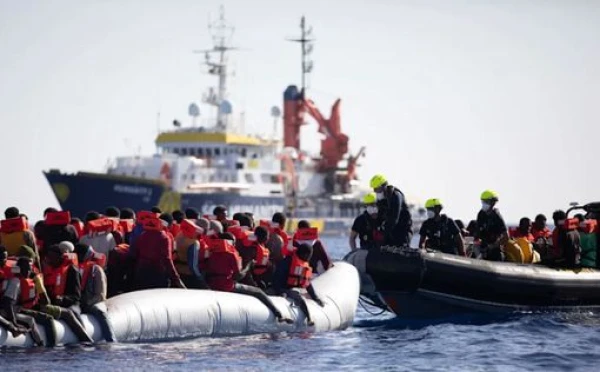
Members of the European Parliament passed two laws tightening migration legislation. They approved the list of "safe countries" and allowed the sending of asylum seekers to third countries with which they have no connection.
The European Parliament (EP) has finally approved new, stricter rules regarding asylum provision in the EU. On Tuesday, February 10, during a plenary session in Strasbourg, 408 deputies supported the creation of a list of "safe third countries," which will now include Bangladesh, Egypt, India, Colombia, Kosovo, Morocco, and Tunisia, as reported on the EP website.
184 members of the European Parliament opposed the approval of the "safe countries" list, while another 60 abstained. The creation of such a list will affect asylum applications in the EU. Applications from individuals from these countries will now be processed faster and will be rejected in most cases.
Additionally, candidate countries for EU membership (in particular, Serbia and Turkey) will be considered safe countries if there is no war or serious threats to human rights in those countries. Such lists had previously been maintained by individual EU member states, including Germany.
"Rwandan" Model: Migrants Can Be Sent to Third Countries
Furthermore, the European Parliament approved a regulation on the application of the "safe third countries" concept. It was supported by 396 deputies, opposed by 226, and 30 abstained. The new rules will allow EU countries to deport refugees to asylum centers in countries with which they have no connection.
This model was previously tested by the United Kingdom and has been dubbed the "Rwandan" model. EU countries can enter into agreements with third countries to accept asylum seekers, who will be able to submit their applications there.
Among other things, it is noted that asylum applications in the EU can also be denied if the applicant has passed through a third safe country and could have requested "effective protection" there, or if that country has an agreement with the EU to accept asylum seekers (excluding unaccompanied minors).
New Rules to Come into Effect in June
These rules are part of a package of EU measures on migration and asylum that is set to come into effect in June 2026. Some provisions may be applied earlier. This decision still requires formal approval from the European Council.
Earlier, DW reported that Russia and Belarus are positioned as hostile states in the new EU migration strategy, and although they are not directly mentioned in the visa strategy, issuing visas to their citizens may become "inappropriate." At the same time, the EU has readmission agreements with both Russia and Belarus, meaning that both countries are still considered places to which migrants can be returned.
So-called humanitarian visas can still be issued, but each case is considered individually based on exceptional personal circumstances. However, EU member states are not obliged to issue humanitarian visas to individuals wishing to apply for asylum, although they may be granted on a case-by-case basis, even if the usual entry conditions are not met.











Leave a comment