
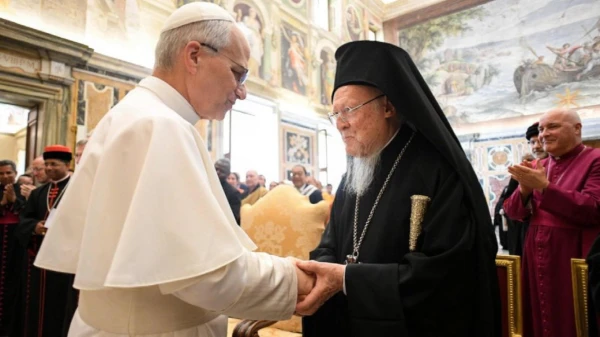
The name of God cannot serve as a cover for enmity and hatred.
The first foreign visit of Pope Leo XIV was expected to be extremely challenging. Several lines of tension converged in one trip: war and the desire for peace, relations between Christians and Muslims, new prospects for Orthodox-Catholic dialogue.
The choice of Turkey for the first foreign visit was largely predetermined: this trip was planned by Pope Francis and was initially scheduled for the end of May, but was postponed due to his passing. It was impossible to miss the 1700th anniversary of the First Council of Nicaea — one of the central events in the history of Christianity, common to both Eastern and Western churches. Organizing the visit required incredible diplomatic efforts: coordinating state and church protocols, strict security measures, and not least — theological formulations of the joint declaration of Catholics with Orthodox.
Symbol of Faith
Leo XIV held talks in Ankara with Turkish President Recep Tayyip Erdoğan, making a symbolic stop at the mausoleum of Atatürk, and spoke about the need to end wars and Turkey's role as a "bridge between East and West," as a country that "can and must be a source of stability and peace" in the region. In these formulations, a direct political support is easily discernible: Ankara receives confirmation from the pope of the very image of the country that it persistently promotes in its own diplomacy. And Leo XIV agreed to remain silent about the burning issue — the transformation of Christian churches into mosques, primarily Hagia Sophia.
Then there was a flight to Istanbul and a meeting with the Catholic community at the Holy Spirit Cathedral and representatives of Christian denominations at the Syrian church. A helicopter then took Leo XIV to İznik, while Ecumenical Patriarch Bartholomew and representatives of other Christian churches traveled to this small town by bus, under heavy security. The pope then visited the Blue Mosque and held a mass at Volkswagen Arena.
Not everyone knows the name of the Byzantine city of Nicaea, now İznik, but for the Church, it is a crucial coordinate — both theologically and historically. In 325, bishops from all over the Christian world gathered here for the First Ecumenical Council to answer the fundamental question of Christian doctrine: who is Jesus Christ? The Christian world was divided. Arius and his followers taught that the Son of God is a creation, albeit the highest, but not equal to the Father.
The council rejected this position and proclaimed: Christ is "consubstantial with the Father" (Greek: ὁμοούσιον τῷ Πατρί), meaning He possesses the same divine nature as God the Father. This is not a philosophical nuance. If Christ is merely a creation, then Christianity becomes one of the forms of worshiping a mediator between God and people. If He is the true God who became man, then in Him all humanity truly connects with God.
The Nicene Council chose the second path and enshrined it in the Symbol of Faith.
It was to this experience that Leo XIV and Bartholomew turned as they headed to İznik — not for a conference, but to the ruins of the ancient basilica of St. Neophytus by the lake. And this is a powerful image in itself: the place where, according to archaeological excavations, the participants of the council once gathered — is now in ruins. Another tragic page in the history of Christianity.
Unity is Possible
The Turkish authorities did everything possible to ensure that the anniversary did not turn into a mass Christian celebration. A very small group of officials and journalists — literally a few dozen people led by the pope and the patriarch — traveled to İznik. No pilgrimage groups, no solemn processions, no public participation. The anniversary of the great council was marked with extreme modesty, under the control of state security services. And this was a conscious choice by Ankara: to allow a symbolic gesture, but not to let it gain mass dimensions.
The central event of this pilgrimage was the joint recitation of the Nicene Creed in its unchanged formulation — without the later addition of Filioque, which divided East and West. The pope and the patriarch uttered the same words that formed the basis of the Nicene confession, thereby demonstrating that fundamental agreement on the question of the person of Christ has not been lost. This was not only a theological gesture but also a declaration of intentions: unity is possible. And the movement towards it is joint prayer and a common doctrinal foundation.
It is no coincidence that protests arose here. Nationalist and Islamist groups brought protesters to Bursa and İznik with placards saying "We are not in Byzantium!" and accusations of an "ecumenical conspiracy." The actions were few in number but not unnoticed: part of Turkish society reacts painfully to both the return of Christian memory of Nicaea and any strengthening of the role of Christian communities. The papal visit is a reason for discussions about "external interference," and the connection "Rome — Phanar" is particularly irritating: the Ecumenical Patriarchate in this context appears more influential, no longer just an internal institution of the Republic of Turkey but also a conduit for "external influence."
The meeting of the pope with Bartholomew in Istanbul continued the Nicaea dialogue. In the patriarchal church of St. George, they prayed together again, then signed a joint declaration. The text emphasizes that the desire for unity is not a diplomatic project but obedience to Christ's prayer "that they may all be one"; unity is described as a goal that must be "pursued with patience, through dialogue in truth and love."
It specifically mentions the search for a solution that would allow Catholics and Orthodox to celebrate Easter on the same day each year, so that "the joy of the Resurrection could resonate in the world with one Christian voice." For the Eastern and Western Churches, which have preserved the same rules for calculating the date of Easter adopted at the same Nicene Council but use different calendars, this would be an important step towards unity.
The key moral motive of the declaration is the rejection of religious justification for war. The pope and the patriarch declare that they categorically reject any use of religion to legitimize violence, terrorism, and aggression: the name of God cannot serve as a cover for enmity and hatred. This appeal is directed simultaneously at politicians who use religious language for military purposes and at religious leaders who too easily agree to justify state policy. It is clear that these statements are a direct criticism of the position of the Russian Orthodox Church regarding the war in Ukraine.
From Istanbul, Leo XIV went to Lebanon, where he held an open-air mass, prayed at the site of the explosion in the Beirut port, and met with representatives of Christian denominations. The country is in a deep economic and political crisis, and the mere reminder that the outside world is ready to listen to the voice of Lebanese Christians and Muslims became a gesture of support.
The return to Nicaea is a powerful image, filled with both hope and anxiety. Perhaps it is key to understanding possible paths to Christian unity. The anxiety is related to the fact that only anniversary dates lead to real actions. The hope is that Rome and Constantinople are now speaking not only of the desire for unity but also of ways to achieve it.




Leave a comment