
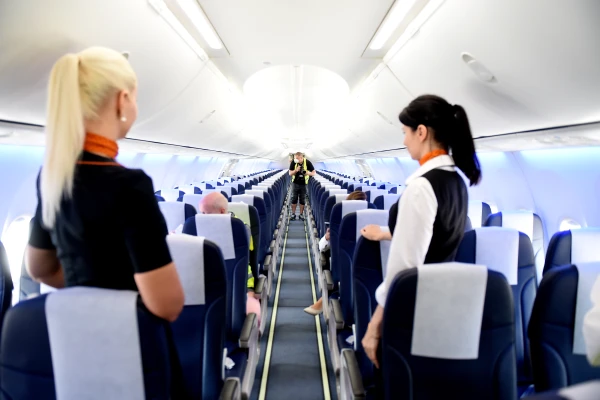
Critics say Transportation Secretary Sean Duffy's video campaign romanticizes an era that they believe never truly existed.
U.S. Transportation Secretary Sean Duffy is urging Americans to dress more appropriately and look tidy while flying. The response to his request has been swift and largely skeptical.
In anticipation of what the Federal Aviation Administration (FAA) has declared the busiest Thanksgiving travel period in 15 years, Duffy launched a new campaign titled "The Golden Age of Travel Begins with You."
A video from the Department of Transportation juxtaposes footage of orderly terminals from the 1950s and 1960s with recent clips showing passengers fighting, stretching bare feet into the aisle, and arguing with flight attendants.
In the video, Duffy states, "Politeness doesn’t end at the boarding gate. Are you dressing with respect?"
Speaking at Newark Airport, he elaborated on his clothing appeal: "Let’s try not to come to the airport in flip-flops and pajamas."
Travelers Feel the Campaign Misses the Point
The call has sparked a wave of criticism on social media.
Many travelers noted that air travel is becoming increasingly stressful, rather than the opposite, and urged Duffy to focus on crowds, prices, delays, and security checks.
Bluesky user Terri De wrote: "It’s not the 1950s when flying was actually enjoyable. Now we’re packed in like cattle, and it’s almost like taking a bus."
Another Bluesky user added: "As long as there’s a real chance of sleeping on the airport floor due to flight delays, I’m going to wear whatever I want."
Incidents on the Rise, but Comparisons Are Difficult
According to the U.S. Department of Transportation (DOT), the campaign aims to reduce the level of violence and disorderly conduct in terminals and on board. Since 2021, the agency has recorded 13,800 incidents involving unruly passengers, with one in five flight attendants reporting physical confrontations.
Such incidents have increased globally.
According to the latest data from IATA, collected from over 60 airlines, there was one incident for every 395 flights in 2024.
But aviation historians urge looking at these figures in context.
In the 1950s, smoking was allowed in airplane cabins, hijackings occurred more frequently than today, and flight attendants were hired under strict appearance-based rules.
At that time, fares were higher, so far fewer people flew.
However, aviation disasters were much more common. According to Airbus, the annual frequency of fatal accidents has decreased from 10 per million flights in 1961 to nearly zero today.
In sum, the so-called golden age of travel was far from the shining era Duffy envisions in retrospect.
Duffy's call comes at a time when many airlines are relaxing uniform requirements.
In Australia, low-cost carrier Bonza completely abandoned formal uniforms in 2022. Flight attendants and pilots can wear t-shirts, shorts, and dresses with Bonza branding. Visible tattoos and optional makeup are allowed. Former Chief Commercial Officer Carly Povey stated that the goal is to create something "fun, bright, and reflective of today."
In the U.S., Alaska Airlines revised its dress code in 2022, eliminating strict male and female options. The company introduced gender-neutral outfits for all employees and allowed makeup, nail polish, two earrings in each ear, and nose piercings.
United Airlines permits some visible tattoos and long hair for employees of any gender, while Virgin Atlantic removed mandatory makeup requirements for women in the crew in 2019 and relaxed tattoo rules in 2022.
In the Maldives, the approach to informality goes even further: on Trans Maldivian Airways, pilots sometimes fly barefoot or in flip-flops.
A Call for Politeness or a Misunderstanding of the Problem?
Despite the mixed responses, Duffy's call has found some supporters. One Reddit user wrote: "As long as everything is covered, I don’t care what you wear. More politeness — I can support that."
Aviation experts agree that a minimum level of politeness, both towards flight attendants and fellow passengers, makes travel safer and more tolerable.
But many critics argue that the minister's message ignores the structural problems of modern air travel: cramped cabins, overworked crews, ultra-low-cost pricing models, and airports operating at capacity. Not to mention the lack of alternatives to flying.
Another Reddit user wrote: "Once upon a time, flying was a pleasant experience. It’s not anymore. Airlines treat passengers like cargo."
"The best way to fix the air travel situation: expand and develop the domestic rail network so that people have alternatives to short domestic flights."
Whether passengers are in pajamas, jeans, or tuxedos, few doubt that the outbreaks of conflict in the air are fueled more by stress than by sweatpants.














Leave a comment