
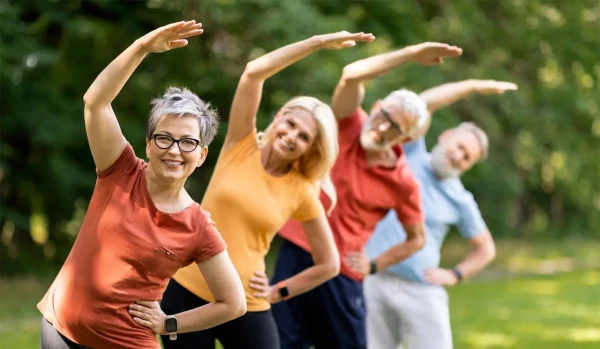
As we age, balance no longer seems like something "taken for granted." But the good news is that it can and should be trained.
Once, standing on one leg, easily climbing stairs, or walking on an uneven path was elementary. As the years go by, the body changes, and so does balance. It is completely natural that after the age of 40, the ability to maintain balance begins to gradually decline, and after 60, it decreases even faster, as reported by EatingWell.
The reasons are a decrease in muscle strength, slower reaction times, and a worsening sense of body position in space. That is why ordinary daily activities can suddenly seem more complicated or even dangerous. Almost one in three older adults falls each year, and a quarter of such falls lead to serious injuries.
But balance is not a death sentence of age. Regular balance exercises do improve stability and reduce the risk of falls. The main thing is to just start.
The Importance of Balance Training
Balance is not just about "not falling"; it’s about confidence in every movement when you climb stairs, reach for something on a shelf, get out of a car, or walk around the city.
Balance exercises should be as important a part of your movement routine as cardio or strength training. They activate small stabilizing muscles, train the brain and body to work together, and slow down age-related changes.
Standing on One Leg with Support
One of the most effective and simple balance exercises. When you reduce the base of support, the brain and muscles learn to respond faster and maintain the center of gravity.
How to perform: Stand next to a table or wall, lift one leg, and hold the position for 20-30 seconds. Repeat on the other side.
Benefits: Strengthens the feet, ankles, hips, and core — everything responsible for stability in daily life.
Heel-to-Toe Walk
This exercise looks simple but wonderfully trains movement control and coordination.
How to perform: Step forward, placing the heel of one foot directly to the toe of the other, as if walking along an imaginary line.
Benefits: Improves gait, posture, and body awareness in space — everything that helps you move confidently and smoothly.
Standing Up from a Chair
A functional exercise that we perform dozens of times a day and often don’t realize how important it is.
How to perform: Sit down and slowly stand up from the chair, keeping your feet on the floor and controlling the movement.
Benefits: Strengthens the legs and thighs, teaches even weight distribution, and maintains balance in motion.
Hip Hinge with Support
This exercise trains balance dynamically, as the center of gravity shifts forward and backward.
How to perform: Stand with your back to a wall, slowly hinge your hips back, keep your back straight, and then return to the starting position.
Benefits: Strengthens the glutes, hamstrings, and core — key muscles for stability and posture.
Side Leg Raises While Standing
Balance is not just about moving forward and backward, but also controlling movements sideways.
How to perform: Shift your weight onto one leg, slowly lift the other leg to the side, and keep your core stable.
Benefits: Activates the muscles that keep the pelvis level and prevent the body from "tipping over."
Step-Ups
An ideal exercise for those who want to feel confident on stairs.
How to perform: Step onto a low platform or step, controlling the ascent and descent.
Benefits: Develops leg strength, balance, and coordination — everything that helps prevent falls.
Safe Training
- Keep a support nearby, such as a wall or chair.
- Train in a clean space without unnecessary objects.
- Choose comfortable, non-slip shoes.
- Move slowly and mindfully.
- Engage your core muscles, as they are the "anchor" of balance.
It is advisable to perform exercises 2-3 times a week. It is regularity, not intensity, that yields the best results. Balance is trained gradually, and confidence in the body returns just as gradually.
After 50, balance becomes a necessity rather than a bonus. However, the good news is that it can be trained at any age. A few simple exercises and their regularity can make everyday movements easier, safer, and more enjoyable.















Leave a comment