
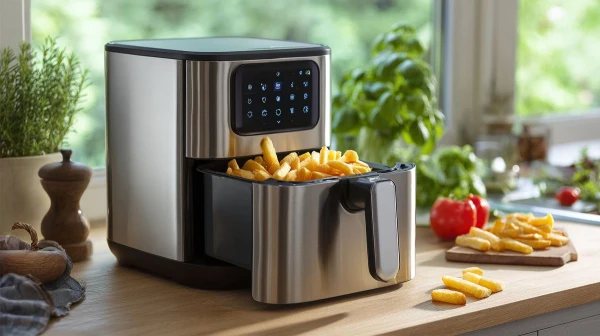
Consider what dishes you cook most often: it may be optimal to use these appliances in tandem, complementing each other's capabilities.
The air fryer has become one of the most popular kitchen appliances today. It can largely replace the oven, allowing for a "set it and forget it" cooking mode, and it is also much easier to clean than a traditional oven or stove. However, like any appliance, the air fryer has its pros and cons. Not all dishes come out better in it, and sometimes traditional cooking methods win out. So, when is the air fryer a true lifesaver in the kitchen, and in what cases will a traditional oven or even a regular frying pan yield better results?
Advantages of the Air Fryer
Speed and Time Savings
The air fryer cooks dishes noticeably faster than an oven. Thanks to powerful convection, hot air circulates evenly, the appliance heats up almost instantly, and cools down just as quickly, reducing the overall cooking cycle. In practice, this saves time: for example, a cottage cheese casserole bakes in about 15 minutes instead of around 40 in a conventional oven, and cookies take about 6 minutes instead of 20.
Crispy crust without excess oil Due to the intense airflow in the small chamber, the air fryer is known for its ability to give foods a crispy crust with almost no oil. In a deep fryer or on a skillet, this effect is achieved with a lot of fat, whereas in an air fryer, it is enough to lightly spray the ingredients with oil (and sometimes you can do without it altogether).
Compactness and Energy Savings
Compared to a bulky oven, a countertop air fryer is much more compact. It is easier to place even in a small kitchen, and if necessary, it can be stored in a cabinet or taken to the country house. The small chamber requires less energy to heat: on average, an air fryer consumes between 0.8 to 1.8 kWh, while an electric oven consumes about 1.5–4.5 kWh (depending on the mode and dish). This significantly affects electricity bills with frequent use of the appliance.
Ease of Use and Functionality
Modern air fryers are very user-friendly: they often come with preset programs, timers, and auto shut-off features. You just need to select the mode — the appliance will maintain the required temperature and time on its own, and will turn off after cooking is complete. There is no need to constantly monitor the process, flip the food, or worry that the dish will burn or dry out. Many models are equipped with additional features (delayed start, keep warm, sensors, etc.), which further simplify life in the kitchen.
Easier to Clean than an Oven
After baking in an oven, it is often necessary to scrub pans and clean burnt fat from the walls. In an air fryer, however, the removable parts (bowl, rack, tray) can be washed right after cooking, many of them are dishwasher safe. Some devices even have a self-cleaning mode. Because of this, maintaining an air fryer is usually easier and quicker than maintaining an oven or cooktop.
Disadvantages of the Air Fryer
Limited Capacity and Portions
Compactness comes with a small chamber volume. The air fryer is most convenient for cooking 2–4 portions, no more. If you need to feed a large family or prepare several dishes at once, the tiny gadget will not be able to handle it. A whole large chicken may physically fit in some air fryers, but it will not cook evenly — hot air has difficulty reaching the center of a large piece. Therefore, for large poultry or baking trays, it is still better to use a spacious oven.
Not Suitable for Certain Foods
The air fryer cannot cook everything. Dishes with a lot of sauce (like lasagna, stew, or spaghetti in sauce) cannot be made in it — the powerful airflow will splash the liquid around the chamber, risking damage to the appliance. Foods in liquid batter also do not work: the batter simply drips through the rack before it can form a crust. For example, classic fried fish in beer batter or donuts are better made traditionally on the stove. You also cannot boil soup, porridge, or pasta in an air fryer — you need a pot of water on the stove or a multicooker for that. Even popping popcorn in an air fryer is not recommended: the kernels do not heat well and can get stuck inside, which can lead to burning and even fire. In short, the air fryer is designed only for dry heat cooking methods; it does not replace a pot or kettle.
Needs space and separate storage The air fryer will require space on the countertop or shelf. This can be a problem in a small kitchen: the appliance is quite bulky, and it needs space around it for air circulation while in use. Additionally, the air fryer should not be placed too close to a wall or under a hanging cabinet due to high temperatures and steam output. You will need to think about safe placement.
Regular Maintenance After Each Use
Although cleaning the air fryer container is easier, it must be done after each use. Fat and juices from foods settle on the lid and heating element, and it is important to clean them; otherwise, old residues may smoke and spoil the taste during the next use. Many cooks clean their ovens only periodically, not strictly every time — with the air fryer, there is no such "grace period." This means that the time spent on cleaning is frequent, albeit on a smaller scale.
Cost of Quality Models
The simplest air fryer can now be purchased inexpensively; however, the functionality and reliability of budget appliances leave much to be desired. For a quality multifunctional air fryer from a well-known brand, you will have to pay a price comparable to that of a mid-range oven. For some, this is an unjustified expense, especially if the kitchen is already equipped with a good oven.
When the Air Fryer is a Lifesaver
Now let's talk about when the air fryer is truly indispensable. Here are situations and dishes where this gadget performs best.
Replaces Frying for Potatoes and Snacks
The air fryer excels at making homemade French fries, chips, nuggets, wings, and other dishes that are usually deep-fried. It produces a golden crust, like frying in oil, but the dish is much less greasy and calorie-dense — an excellent option for those who prefer healthier eating. Moreover, there is no need to heat liters of oil and then wonder what to do with it. For the best results, it is recommended to cook in small batches at high temperatures (~180–200 °C), lightly spraying the pieces with oil, and then the potatoes or nuggets in the air fryer will come out crispy and golden much faster than in the oven.
Meat, Poultry, and Fish with a Crispy Crust
If you love chicken with a crispy skin, juicy steaks, or baked fish, the air fryer will be your helper. It excels at cooking chicken wings, drumsticks, ribs baked with vegetables, and skewers of meat or fish. Thanks to powerful convection, the meat is seared on the outside to a grilled effect while remaining juicy on the inside. Breaded snacks (cutlets, schnitzels, cheese sticks) also turn out great in the air fryer — it takes only a minimal amount of oil for the breadcrumbs or batter to become golden. Tip: large pieces (like a thick steak or duck breast) should be cooked at 180–190 °C for even doneness, while small pieces can be cooked at 200 °C for a quick crust. Cooking time is significantly less than in the oven: for example, portioned chicken wings will be ready in about 20 minutes at 200 °C (it would take about 40 minutes in the oven).
Grilled Vegetables and Quick Side Dishes
Vegetables in the air fryer turn out just as good as on a grill pan or in the oven. Zucchini, eggplant, bell peppers, cauliflower, pumpkin, broccoli — all these vegetables bake excellently with hot air and retain their juiciness. You can make homemade vegetable chips (for example, from thinly sliced potatoes, beets, or even kale) — they will dry out and brown evenly. For baked vegetables, set the temperature to ~180 °C and cook for about 10–15 minutes (exact time depends on the size of the pieces). It’s worth opening and stirring the contents of the basket a couple of times for even cooking. In just a quarter of an hour, you will have a delicious side of grilled vegetables without excess oil and fuss.
Quick Hot Snacks and Small Batch Baking
The air fryer is a lifesaver when you need to prepare a small hot snack. It can serve as a toaster or mini-oven. For example, pastries or mini-pizzas bake in just a few minutes. A flaky croissant with cheese and ham for breakfast can be baked in the air fryer in about 3–5 minutes at 180 °C — the bread will become crispy, the cheese will melt, and all this without the long preheating of an oven. Hot sandwiches, cheese toasts, sausages in dough, baked apples, and other small items can also be prepared just as quickly. Small cookies or muffins also turn out well in the air fryer — they bake faster than in a conventional oven, although not too many can fit at once. For an experiment, you can even bake a sponge cake in a small mold — at a temperature of ~160 °C, it will bake through, but keep in mind that high baking may rise unevenly due to the tightness of the chamber. Overall, for large cakes and complex desserts, it is better to use the oven.
When the Oven or Skillet Performs Better
Despite all the advantages, the air fryer sometimes loses to its more traditional counterparts. There are situations when the good old oven or stove will yield better results in terms of taste, texture, or simply be more convenient. Let's consider the main cases when a classic oven or skillet is preferable.
Large Volumes and Holidays
If you need to prepare food for a large group, the oven is unbeatable. A whole tray of meat or fish dishes, baked vegetables with a side dish, or a large pie can all fit in the oven at once. The air fryer, on the other hand, is designed for small portions and physically cannot hold a lot of food at once. Additionally, when you need to serve several dishes at different temperatures for dinner (for example, roasting meat and baking a pie at the same time), it is easier to use two tiers of the oven than to cook everything sequentially in one small appliance. Conclusion: for a large family or those who like to cook for several days in advance, the oven is still essential.
Baking and Desserts in Large Pans
Baking bread, large sponge cakes, pastries on a tray, or shaping cookies in large quantities is the domain of the oven. The temperature in the oven remains more stable, the volume is larger, and the dough rises evenly. The air fryer can help with baking small batches, but it cannot replace a full oven for serious baking. If you often bake bread, yeast pies, or cookies for the whole family, you cannot do without a classic oven.
Stewing, Braising, and Saucy Dishes
Any recipes that involve liquid (water, broth, sauce) or long simmering under a lid require a pot or Dutch oven. Roasts, stews, soups, porridges, sauces — all of these are cooked on the stove or in the oven in deep cookware, but not in an air fryer. In the dry heat of the air fryer, such dishes will either dry out or be impossible to make (as mentioned, it does not boil water). So, the skillet and pot remain indispensable for soups, pilafs, goulash, sauces, and other "wet" culinary tasks.
Quick Frying and Certain Types of Dishes on the Stove
The familiar skillet is sometimes simpler and better than the air fryer. Fried eggs or pancakes will be ready in a couple of minutes on the stove, while they are simply impossible to make in the air fryer. Many prefer a marbled beef steak cooked on a hot skillet to achieve a flavorful crust with butter and herbs — it will also taste good in the air fryer, but without the characteristic flavor of frying in oil. Pasta and rice are always boiled on the stove, not baked with hot air. Additionally, if you need to quickly reheat or prepare something small (like sautéing a handful of mushrooms for an omelet, melting butter, or browning onions), it is often easier to heat the skillet than to use an entire appliance. The good old stove provides more control in certain techniques (take, for example, Asian stir-fry, which requires high heat and stirring — the air fryer cannot do that). Thus, the skillet and oven perfectly complement the capabilities of the air fryer: each technique is good for its tasks.
Ultimately, the choice between an air fryer and an oven depends on your cooking habits and tasks. In a modern kitchen, there is room for both traditions and high-tech innovations.















Leave a comment