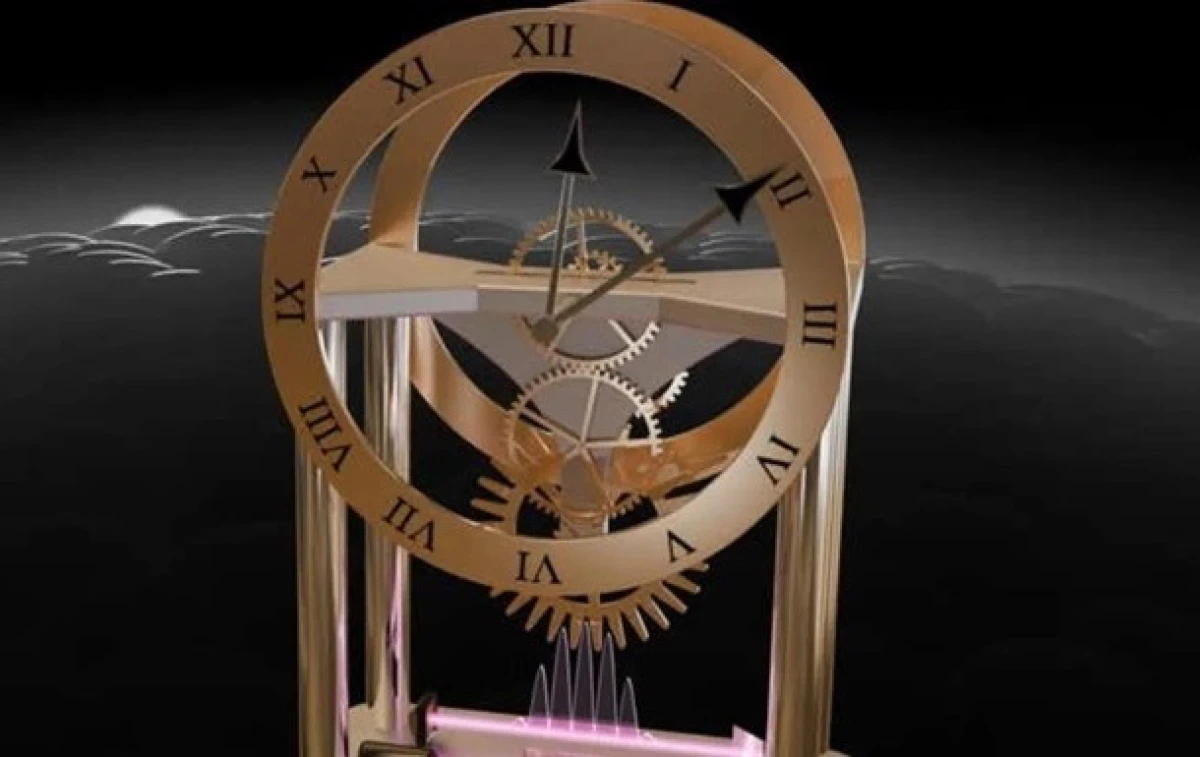
Physicists from Austria have presented the world's first operational nuclear clocks. The new device promises to be the most accurate timekeeper in history and assist in the search for unknown laws of nature.
Researchers from the Vienna University of Technology have announced the creation of the world's first operational nuclear clocks. This development is considered a significant breakthrough in physics and may open new opportunities for studying the fundamental properties of the universe.
Unlike modern atomic clocks, which measure time based on the oscillations of electrons around the atomic nucleus, the new technology utilizes changes in the energy state of the atomic nucleus itself.
To create the device, scientists used a rare isotope of thorium-229. Its nuclei were embedded in calcium fluoride crystals and subjected to ultraviolet laser radiation. The feature of thorium-229 is that it requires a relatively small amount of energy to change the state of its nucleus.
Work on the project lasted more than twenty years. The idea of creating nuclear clocks was first proposed back in 2003, but it was only recently that it could be implemented in practice.
According to the researchers, the nucleus of an atom is much better protected from external influences than the electron shell. As a result, nuclear clocks could be significantly more accurate and stable than the most advanced atomic clocks used today.
The new technology has already been applied in research on dark matter — a mysterious substance that, according to scientists, makes up a large part of the matter in the universe. The use of nuclear clocks has allowed for the refinement of parameters in some theoretical models of ultra-light dark matter.
Despite successful testing, the developers acknowledge that the device is still in the early stages of development and requires further improvement.
The emergence of the first nuclear clocks could mark the beginning of a new era in precise measurements. Scientists hope that in the future, this technology will help discover unknown physical phenomena and bring humanity closer to unraveling the greatest mysteries of the universe.