
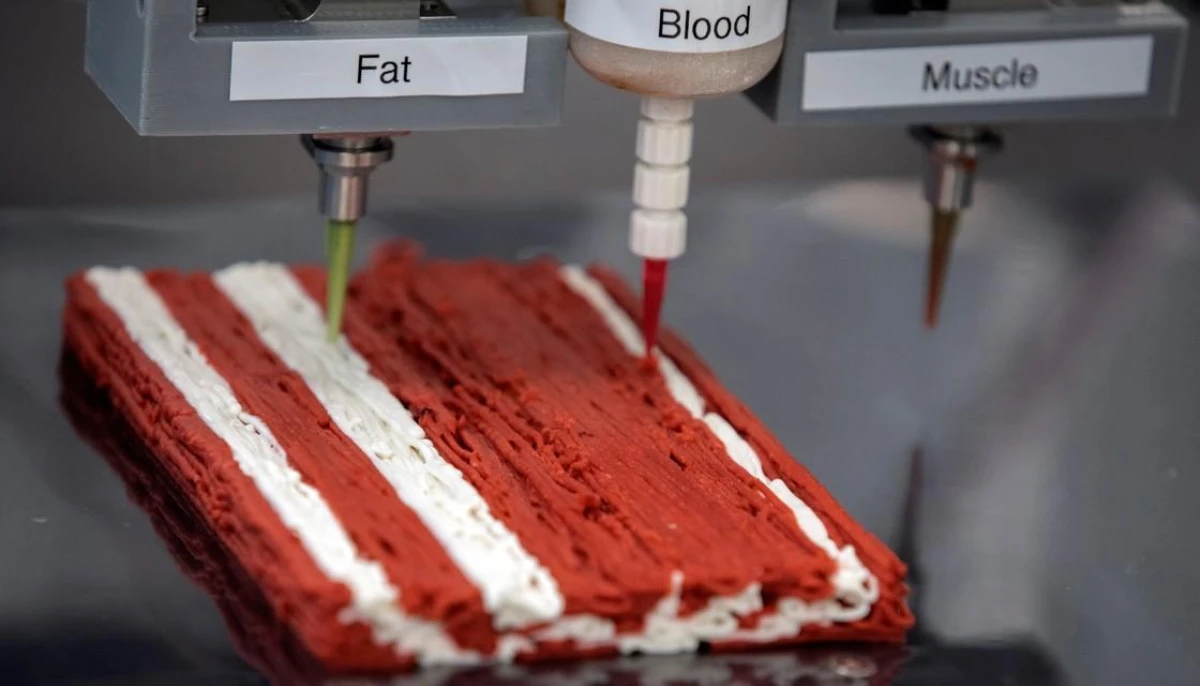
The microscopic tunnels of the scaffold mimic the natural structure of muscle tissue.
Researchers from the Hebrew University of Jerusalem have created an inexpensive steak with a realistic texture of regular meat from cultivated cells.
The new method allows for a radical reduction in the cost of producing structured artificial meat. The main economic problem in this field has been the high price of growth factors, which account for more than 95% of all expenses. The scientists found a solution: instead of dissolving expensive proteins in a liquid medium, they anchored them to a porous scaffold. This approach reduced the use of valuable components by ten times. The work was published in the journal Current Research in Food Science.
The basis for growing the steak is a special matrix obtained by the method of directional freezing of plant cellulose. The microscopic tunnels of the scaffold mimic the natural structure of muscle tissue. Stem cells from cows anchored to the cellulose fibers, began to multiply, and arranged themselves in parallel rows. After several weeks of cultivation, the bioengineered construct acquired density and elasticity comparable to that of raw beef steak.
The scientists obtained an analogue of sirloin – a large and fairly dense muscle tissue. Unlike the tenderloin, the muscles of this part of the back are involved in movement, so the meat has pronounced firmness and a noble meat texture. Sirloin is precisely what is used to prepare signature steaks.
Culinary tests confirmed the high potential of the development. When fried, the cultivated meat retained its shape, acquired a characteristic brown hue due to the Maillard reaction, and demonstrated a fibrous structure. Mechanical tests recorded a very close similarity in density between the artificial and traditional fried meat. Usually, artificial meat is much softer than natural meat.
"Using plant-based materials, such as cellulose, allows us to create a structured foundation that directs stem cells to recreate the architecture of meat," noted co-author Professor Oded Shoshev. According to him, the product's behavior during frying confirms that this method provides an authentic sensory experience.













Leave a comment