
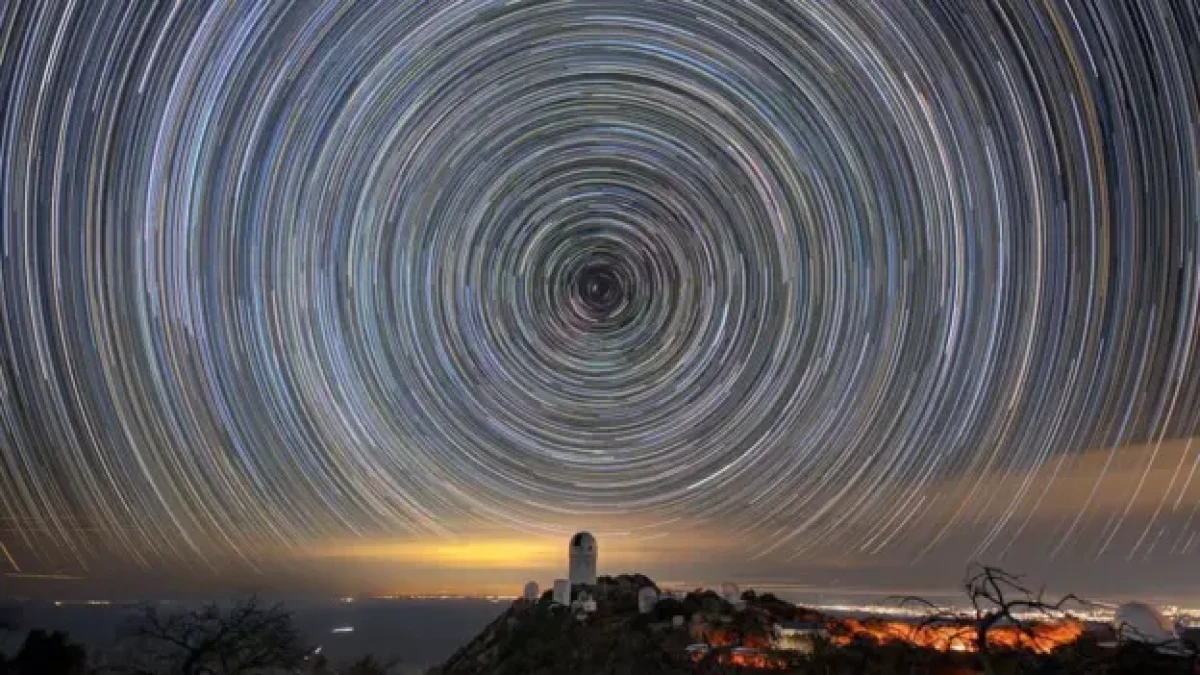
A powerful instrument containing 5,000 fiber-optic "eyes" has created a map of the Universe that could change our understanding of the cosmos.
The Dark Energy Spectroscopic Instrument (DESI), installed on the Mayall Telescope at the Kitt Peak National Observatory in Arizona, has recorded more than 47 million galaxies and quasars, as well as over 20 million stars.
This is more than six times the total number of galaxies and other cosmic objects recorded in all previous measurements.
The images cover a distance of 11 billion light-years. This means that the instrument has managed to capture galaxies at very early stages of development, close to the moment of the Universe's birth, which is estimated to be about 13.7 billion years old, said Luz Angela Garcia, a research astronomer at ECCI University in Colombia.
The new data allow for a better understanding of the structure of galaxies and how they formed, as well as shedding light on the nature of dark energy — one of the greatest mysteries of science.
Observing the Sky
Over five years, the DESI instrument, capable of measuring more than 100,000 galaxies in a single night, has mapped a third of the sky.
Using fiber-optic detectors, the instrument can perform spectral analysis of galaxies and calculate how much the Universe has expanded while the light from these galaxies reaches Earth.
The results obtained by DESI offer a new way to understand dark energy — a component that makes up 70% of the Universe and acts as a force accelerating its expansion.
Did Einstein Get It Wrong? The Dark Matter Map Reveals New Mysteries of the Universe
It has long been believed that dark energy behaves like a cosmological constant — a coefficient that Albert Einstein added to the equations of his general theory of relativity. It explains why the Universe remains in a stable state of expansion, writes Claire Cameron in an article for Scientific American.
Caption for the photo, This small part of the map shows the large-scale structure of the Universe, formed under the influence of gravity. Each point represents a galaxy. The densest areas indicate regions where galaxies and clusters of galaxies have grouped together, forming strands of a "cosmic web." Energy in Evolution New observations confirm the idea, signs of which DESI has long been recording: dark energy does not behave stably, but evolves.
As early as 2025, DESI noted that the anti-gravitational effect of dark energy might be weakening.
As the Universe expands, the distance between galaxies increases, and it is believed that dark energy accelerates this expansion. But if its effect is weakening, then our understanding of the Universe may need to be adjusted.
Today, the scientific community leans towards the idea that dark energy remains virtually unchanged.
"Thus, these new clues herald a future for our Universe that is different from what was assumed since dark energy was included in our cosmic model," Garcia explains.
The findings of DESI could mean that we will have to radically change our models of how the Universe functions, the balance between energy and matter, and what its end will look like.
"If dark energy is not constant and is weakening, it will change the entire paradigm of modern cosmology," said Young Wook Lee from Yonsei University in South Korea to the BBC in 2025.
If this is the case, there is even a possibility that at some point dark energy will weaken enough for gravity to take over again, causing the expansion of the Universe to first stop and then begin to contract again — astronomers refer to this scenario as the "Big Crunch."
Photo of the interior of the Mayall Telescope, located inside its dome. Photo credit, Marilyn Sargent/Berkeley Lab Caption for the photo, The DESI instrument is installed inside the Mayall Telescope in Arizona.
The Big Map
DESI researchers now plan to expand the map by 20% to cover 17,000 square degrees — a unit of measurement used to define the area an object occupies in the sky. For example, the Moon occupies about 0.2 square degrees.
"If you stretch your arm out in front of you, the nail of your pinky finger will cover about 1 square degree," explains astrophysicist Ethan Siegel on the Big Think website.
This expanded version of the map will cover areas near the Milky Way, as well as zones where bright stars or the atmosphere hinder the observation of distant objects.
Scientists also plan to study dwarf galaxies and stellar streams — bands of stars ripped from smaller galaxies by the gravitational pull of the Milky Way.
According to DESI representatives, the goal of the project is to better understand dark matter, this invisible form of matter that makes up most of the mass of the Universe and has never been directly detected. "We are now going beyond our original plan. We don’t know what we will find, but we think it will be quite exciting," says DESI director Michael Levy.












Leave a comment