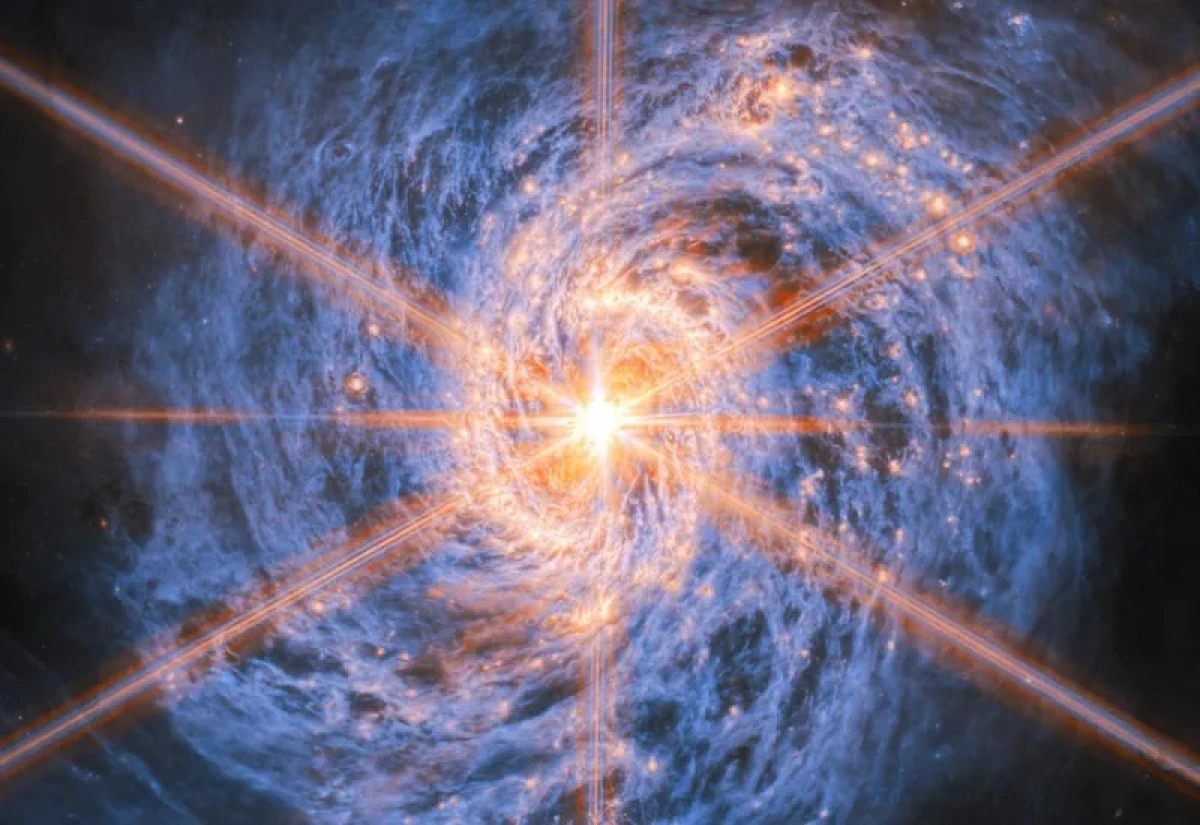
The James Webb Space Telescope has captured a detailed image of the spiral galaxy Messier 77, which contains a supermassive black hole at its center. The galaxy's bright core was able to create characteristic light "rays" in the image, typically seen only with stars.
NASA has released a new image of the spiral galaxy Messier 77, captured by the James Webb Space Telescope. The main feature of the image is the extremely bright active core of the galaxy, which literally overshadows the rest of its structure.
At the center of M77 lies a supermassive black hole with a mass of about eight million suns. A vast amount of gas and dust spirals toward it, heating up to extreme temperatures and creating powerful radiation.
It is this brightness that has resulted in the appearance of long orange rays in the image. However, these are not real structures of the galaxy, but rather so-called diffraction spikes — an optical effect that occurs when intense light interacts with the mirror structure of the Webb telescope.
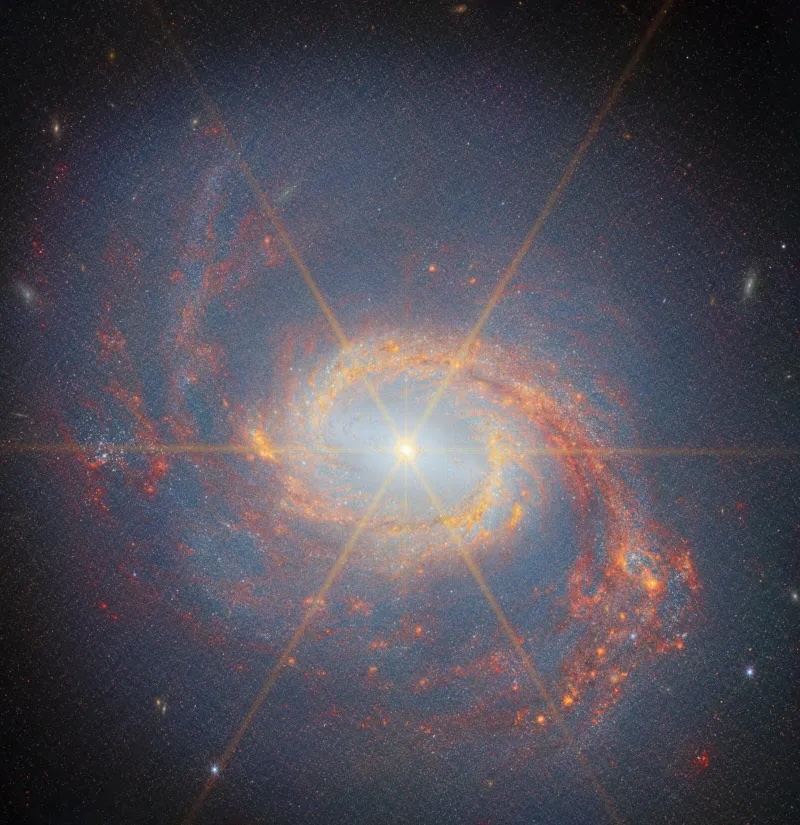
Such six-ray and two-ray structures are often seen in images of bright stars, but in the case of Messier 77, the core of the galaxy turned out to be so bright.
In addition to the active core, M77 is also of great interest as one of the most active star formation regions among nearby galaxies.
The infrared instruments of the telescope allowed scientists to see structures hidden in ordinary visible light. A bright bar has been discovered in the central part of the galaxy, surrounded by a ring of intense new star formation. This is where the rate of star birth is particularly high.
The telescope also captured huge clouds of gas and dust filling the spiral arms of the galaxy. Along them, bright areas of star cluster formation can be seen, creating distinctive "bubbles" in the surrounding material.
Astronomers are particularly interested in the outer structure of the galaxy. Beyond the main spiral arms, long threads of hydrogen gas stretch out, forming a faint outer ring. These thin "tentacles" have given the galaxy its nickname "Squid Galaxy."
The observations were conducted as part of a scientific program to study massive nearby galaxies with active star formation. Thanks to the high resolution of the telescope, scientists can closely examine the processes of star birth, evolution, and death.
Infrared observations are especially valuable as they allow scientists to "peek" through dense clouds of cosmic dust that hide many structures in ordinary telescopes.
Currently, M77 is considered one of the most interesting galaxies for studying the interaction between supermassive black holes and star formation processes.
The new image of M77 demonstrates how detailed the Webb telescope can investigate even the brightest and most complex structures of distant galaxies.