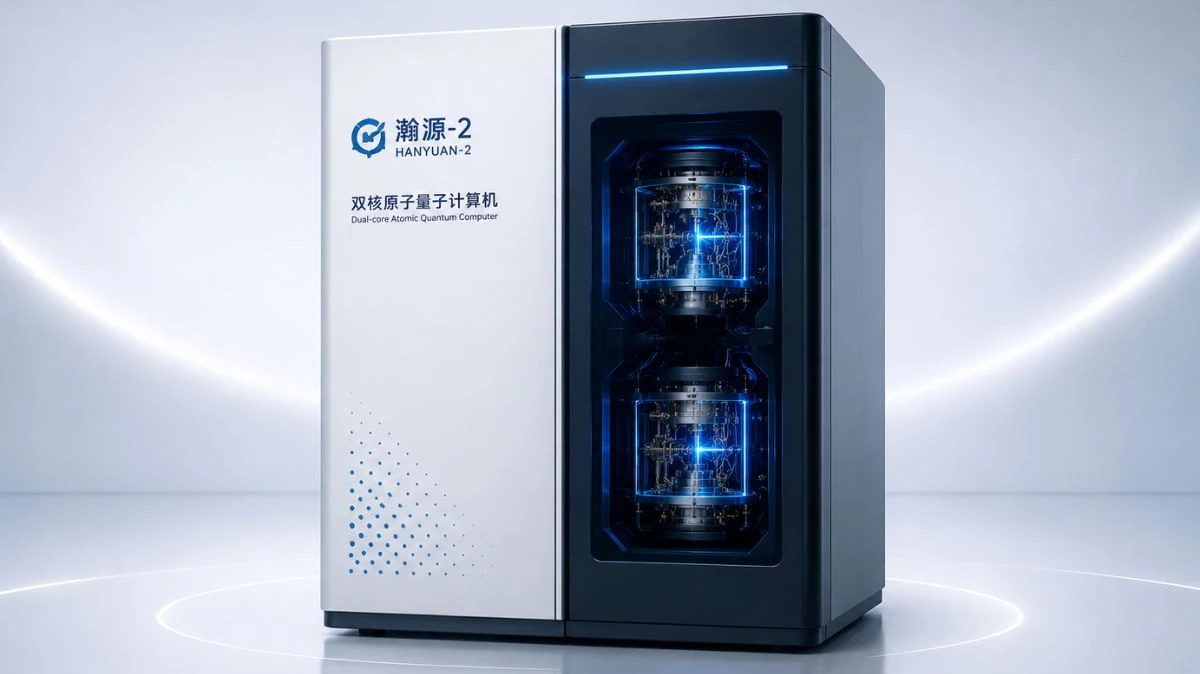
China has introduced the Hanyuan-2 quantum computer with a dual-core architecture and 200 qubits. Developers claim that the system consumes significantly less energy than many modern quantum machines and could be a step towards more practical applications of quantum technologies.
Chinese researchers have announced the launch of a new quantum computer Hanyuan-2, built on neutral atom technology. The project is considered an important milestone in the development of the national quantum program and a transition from experimental research to more applied solutions.
The main feature of the system is its dual-core architecture. Essentially, the computer uses two interconnected quantum processors that can simultaneously distribute computations between themselves and participate in error correction.
Developers believe that this approach can enhance the stability and reliability of computations — one of the main problems of modern quantum computers.
Unlike most existing systems, Hanyuan-2 does not require extreme cooling to temperatures close to absolute zero. The computer is built on neutral atom technology, which is considered more energy-efficient and less complex to maintain.
According to Chinese media, the system consumes less than 7 kilowatts of energy. In comparison, this is comparable to the energy consumption of small server equipment or several household appliances running simultaneously, while many quantum installations require significantly more complex infrastructure.
The computer was developed by CAS Cold Atom Technology, associated with the Chinese Academy of Sciences. The company is headquartered in Wuhan.
The company's CEO, Tang Biao, stated that Hanyuan-2 is designed in a compact format — as an integrated cabinet — and uses a relatively small laser cooling system.
Quantum computers operate based on qubits — quantum bits that allow certain computations to be performed significantly faster than classical computers. Such systems are seen as promising for complex modeling, cryptography, material development, and pharmaceuticals.
However, one of the main challenges in the industry remains the scaling of technologies. Researchers worldwide are still unable to reliably manage millions of qubits, so many companies are focusing on more compact systems with dozens or hundreds of qubits.
Hanyuan-2 uses 200 qubits — significantly fewer than some experimental giant projects, but Chinese developers are betting not on record scale, but on the stability and practical applicability of the system.
Chinese state media claim that key indicators — including the lifespan and reliability of qubits — have already reached a world-class level.
The company has also begun commercializing the technology. The previous model Hanyuan-1, presented earlier, received its first contracts both within China and abroad at the end of last year.
Against the backdrop of a global race in quantum computing, China is actively increasing investments in this area, competing with American and European technology companies.
China is focusing not only on the power of quantum computers but also on their practicality, energy efficiency, and potential for commercial use.