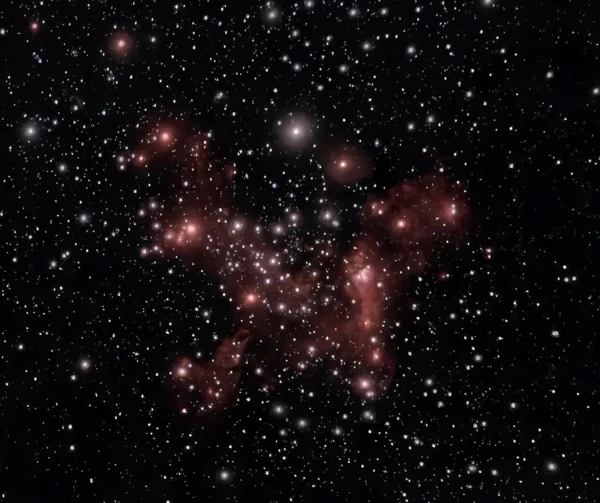
Astronomers have revealed the source of three gas clouds that provide a steady supply of material to the supermassive black hole Sagittarius A*.
A study has revealed what is behind the creation of three mysterious gas clouds that feed the supermassive black hole Sagittarius A* at the center of the Milky Way. It turns out to be a massive binary star located near the black hole, writes Focus.
At the center of the Milky Way lies the supermassive black hole Sagittarius A*, which has a mass approximately 4 million times that of the Sun. It is surrounded by stars, interstellar gas, and dust that move under the extreme gravity of the black hole.
Over the past 14 years, astronomers have discovered three compact gas clouds named G1, G2, and G2t, which are important clues for understanding how the black hole feeds on gas. However, the exact origin and physical processes that shape these clouds have remained unclear.
Previously, astronomers found that the gas clouds have a mass equivalent to several Earth masses, consist of hydrogen and helium, and rotate in an elongated orbit around the black hole.
Calculations have shown that the fall of one such cloud into the black hole every ten years could provide enough material to sustain the current activity of Sagittarius A*. Therefore, understanding how these gas clouds form is key to explaining how the black hole feeds.
Earlier, astronomers suggested that the source of these mysterious clouds could be stellar winds from massive stars, stellar explosions, as well as the gravitational influence of the black hole on interstellar gas.
New observations of the center of our galaxy have shown that all three gas clouds share a common origin. It turns out that the structures were created by the massive binary star IRS 16SW, which orbits the supermassive black hole. Modeling of local conditions confirms the observations.
Astronomers have found that gas clouds can form in areas where the stellar winds of two stars collide with the surrounding environment, creating a shock wave between the two stars. There, gas accumulates and compresses, eventually separating and turning into the gas clouds observed by scientists.
The results of the study suggest that stellar winds from massive stars in the center of the Milky Way may continuously supply material to feed the black hole.