
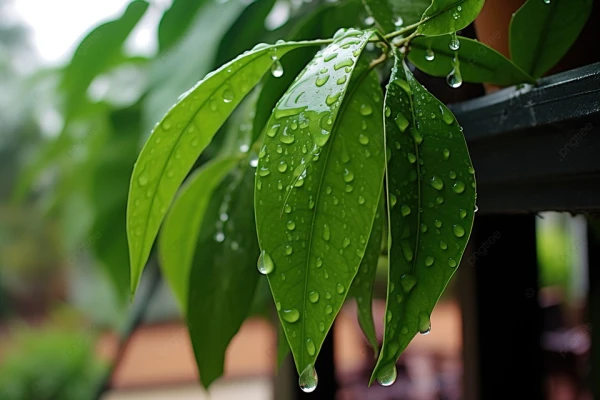
American biologists have made a remarkable discovery: rice seeds are capable of capturing acoustic waves from falling raindrops, which stimulates their germination and response to moisture in the soil.
American biologists have made an astonishing discovery: rice seeds can recognize the acoustic vibrations created by falling raindrops. This ability allows them to respond to the presence of moisture in the soil, and, according to the press service of the Massachusetts Institute of Technology, it can be used to accelerate plant growth.
MIT Professor Nicholas Makris explained that plant seeds have a unique ability to sense sound, which is vital for their survival. The waves generated by falling droplets carry enough energy to activate special organelles in plant cells. These organelles are usually responsible for sensing gravitational force, but their activation triggers the processes of seed germination.
The Amazing World of Plant Senses
Higher plants possess a multitude of remarkable senses: they not only perceive light and respond to its changes, but also react to touches or attacks from pests. Furthermore, they are capable of transmitting signals to their kin and sensing the gravity of the Earth. These complex tasks are performed by specialized cellular structures that are completely different from the sensory organs of animals.
Powerful Sound Waves of Rain
American biologists wondered: do plants have structures capable of responding to sound vibrations from raindrops? The collision of droplets with soil or water generates incredibly powerful acoustic waves. Their strength is comparable to the sound pressure of a jet engine at a distance of just a few meters.
Experiment with Rice Seeds
The scientists meticulously recorded the sound vibrations produced by raindrops on real rice fields. They then reproduced these sounds in laboratory conditions, exposing thousands of rice seeds in test tubes to them. The results of the observations were astonishing: the sound waves accelerated rice germination by an impressive 30–40 percent compared to seeds that were in a quiet water environment without the 'tap of rain.'
The Role of Statoliths in Sound Perception
To capture these vibrations, plants utilize statoliths—microscopic crystals that typically help them determine the direction of gravitational pull. A deep understanding of this mechanism opens new horizons for stimulating seed germination and active plant growth. This could significantly accelerate harvests or effectively restore populations of rare species.
















Leave a comment