
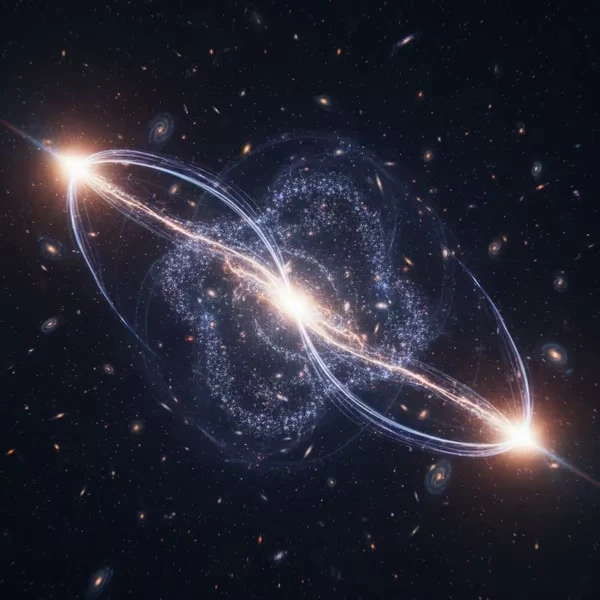
Scientists used signals from distant blazars and the gravitational influence of the Laniakea supercluster to confirm the Weak Equivalence Principle with precision surpassing all previous measurements.
Cosmic Test of Einstein's Principle
An international team of theoretical physicists and cosmologists from China and Poland conducted a unique test of Einstein's Weak Equivalence Principle (WEP). They analyzed high-energy neutrinos coming from the blazars TXS 0506+056 and PKS 0735+178. This groundbreaking research achieved record measurement accuracy, confirming the relevance of WEP on a cosmic scale.
Fundamentals of the Weak Equivalence Principle
The equivalence principle is a cornerstone of the general theory of relativity. It states that the trajectory of any particle in a gravitational field does not depend on its internal nature. The verification of this fundamental proposition was carried out using the Shapiro effect, which describes the relativistic time delay of signal propagation in a gravitational field.
Methodology and the Role of Laniakea
For the first time, the gravitational potential of the Laniakea supercluster was taken into account in the calculations. This gigantic structure, which includes our Galaxy, became a key element for improving accuracy. The research methodology was based on analyzing signal delays from blazars, using publicly available data from the IceCube observatory. Active galactic nuclei, known as blazars, simultaneously generate neutrinos and photons. This makes them ideal cosmic laboratories for testing WEP. The signal delays were 175, 15, and 7 days for TXS 0506+056, and 4 days for PKS 0735+178.
Record Measurement Accuracy
Taking into account the gravitational influence of Laniakea significantly improved measurement accuracy. The results were found to be 1–3 orders of magnitude more precise than in previous studies. The achieved accuracy reaches the order of 10^-7, which exceeds the limits established by data from the supernova SN1987A by 6 orders of magnitude. This convincingly demonstrates that photons and neutrinos travel along absolutely identical trajectories in a gravitational field. The scientific novelty of the work lies in using Laniakea as a kind of "gravitational time lens." This approach significantly increased the sensitivity of the test, allowing for refined limits even for previously studied objects, such as PKS B1424-418, improving the limit from 10^-4 to 10^-6.
Scientific Value and Prospects
The authors of the study emphasize the need for cautious interpretation of the results. This is due to systematic uncertainties arising from internal delays of radiation in the sources themselves. Nevertheless, the work confirms the validity of WEP for relativistic particles with unprecedented precision. In the future, with the commissioning of next-generation detectors such as KM3NeT and CTAO, the statistical sample of events will significantly increase. This will open up opportunities for testing even finer effects and studying physics beyond the Standard Model. Thus, the status of the general theory of relativity as a valid metric theory of gravity will only be strengthened.














Leave a comment