
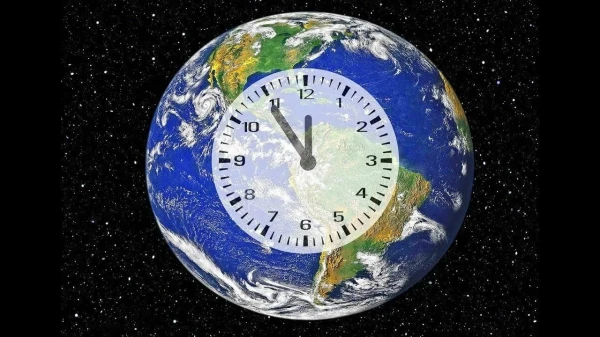
Imagine that the familiar 24 hours in a day are just a fleeting stage in the grand history of our planet. Scientists confirm: the Earth is slowing down, and one day the day will indeed become longer, but these changes occur so slowly that they are imperceptible in everyday life.
If you have ever heard that the Earth will "soon" switch to 25-hour days, the key word "soon" clearly requires rethinking. Scientists confirm: the rotation of our planet is indeed slowing down, but these changes are so negligible that they remain completely unnoticed in everyday life. The very idea is real and boils down to a simple "tug of war" between the Earth and the Moon, where the forces of ocean tides act as a tiny brake, gradually lengthening the Earth's days, as reported by Econews.
Duration of a day: the illusion of constancy
We are used to 24-hour days, as it is based on which we plan our lives: from school schedules to work shifts and alarms. However, if we measure the Earth's rotation relative to distant stars rather than the Sun, we get a slightly different value – the so-called sidereal day, as explained in detail by NASA's Space Place project. This difference is not an error, but merely demonstrates two different approaches to measuring the planet's motion.
The Earth not only rotates on its axis but also simultaneously moves in its orbit around the Sun. Because of this, it has to make a slightly larger turn for the Sun to appear in the same point in the sky again. It is important to note that even the familiar 24-hour "solar days" are not absolutely constant: they fluctuate by negligible amounts and tend to lengthen over very long periods.
How the Moon slows down the Earth
The gravity of the Moon causes the Earth's oceans to bulge, creating tides as the planet rotates. However, these tidal bulges do not perfectly align with the Moon, as the oceans and seabed create friction. This friction gradually robs the Earth of some rotational energy, as described in NASA's explanatory materials on eclipses and the Earth's rotation.
Thus, the Earth's rotation is slowing down, and the Moon is slowly drifting away from us, as there is a constant exchange of energy in this system. To better understand this seemingly abstract process, imagine pushing a spinning office chair. If you lightly touch the floor with your foot while doing so, the chair will continue to spin but will gradually lose speed.
Elusive slowdown: scientists' methods
We are unable to feel how the Earth loses tiny fractions of a second throughout our lives. So how do researchers learn about the changes occurring? They carefully compare the readings of ultra-precise atomic clocks with astronomical observations and extensive historical records, including data on ancient eclipses.
Modern time measurement methods allow tracking small discrepancies between clock readings and the Earth's rotation. That is why organizations like the International Earth Rotation and Reference Systems Service regularly publish official bulletins regarding the orientation and time of our planet. The National Institute of Standards and Technology (NIST) and the United States Naval Observatory explain in detail how additional coordination seconds (leap seconds) are used to synchronize world time with the Earth's rotation, demonstrating the meticulous attention of chronometrists to this process.
25-hour days: when to expect?
It is in this matter that headlines often mislead, creating a false sense of immediacy. There is no specific calendar date that could be circled and awaited. The most well-known estimates point to a timeline of about 200 million years, assuming that the Earth-Moon system continues to evolve according to the current scenario.
One of the key studies underlying this discussion comes from a team at the University of Toronto, as noted in the official review of the Faculty of Arts and Science at that university. Astrophysicist Norman Murray, one of the participants in this work, studies the change in the length of the Earth's day over deep time.
So yes, 25-hour days are indeed "on the schedule" of our planet's evolution. However, this is such a distant future that it will have no impact on people, civilization, or even the familiar form of our calendars in any practical sense.
What else affects the length of a day?
Although tides are a long, slow rhythm, they are not the only factor affecting the duration of a day. The Earth's rotation can change slightly when masses move across the planet, such as during ice melting or large-scale redistribution of water resources. The connection between climate-driven mass changes and the Earth's rotation was highlighted in a NASA review on the impact of ice and groundwater.
These effects manifest on tiny scales, but they clearly show that the length of a day is shaped by many processes. Even large engineering projects could theoretically have a measurable impact, which is why some readers link this topic to materials like the ECOticias report on a project affecting the Earth's rotation. This serves as a reminder: despite the precision of measurements, the Earth is not an absolutely rigid top.















Leave a comment