
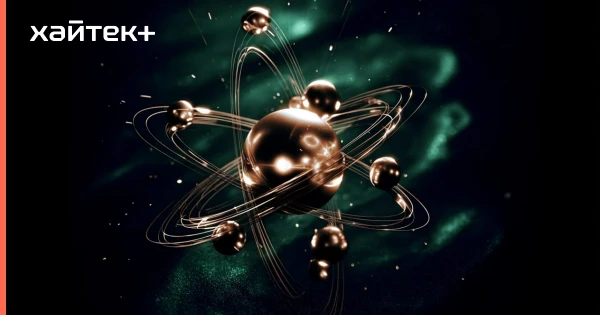
The origin of mass is one of the most intriguing questions in physics. Modern theories suggest that the mass of objects arises from the properties of vacuum, and to test this hypothesis, scientists are actively investigating meson nuclei. Recent experiments have yielded sensational results, confirming the existence of the long-awaited yet still unobserved exotic atomic state — a nucleus bound to the η′-meson.
Mesons are fascinating particles made up of a quark and an antiquark. They possess a unique ability to temporarily merge with an atomic nucleus, forming mysterious meson nuclei.
Among them, the η′-meson stands out, drawing the keen attention of physicists. This particle is remarkably heavy compared to its "relatives," making it truly special.
Scientists suggest that within nuclear matter, the mass of the η′-meson may change. Observing this phenomenon promises to unveil crucial secrets about how particle mass is formed throughout our vast Universe.
Experiment Procedure
To unravel this mystery, an international group of researchers organized a high-precision experiment. It took place at the prestigious Helmholtz Center for Heavy Ion Research located in Germany.
During the experiment, a powerful beam of high-energy protons was directed straight at a carbon target. This interaction excited the carbon nuclei, provoking the emergence of η′-mesons, potentially capable of forming bound states with the nucleus.
The scientists meticulously measured the excitation energy of the carbon nuclei, focusing on analyzing deuterons emitted during the reaction. For this purpose, a high-precision Fragment Separator (FRS) was employed.
To finely track the high-energy protons and accurately identify signals indicating the capture of the η′-meson, the team used the advanced WASA detector, developed and built by Swedish experts.
Sensational Results
Ryōhei Sekiya, the lead author of this exciting scientific work, shared his thoughts: "With our new experimental setup, combining FRS and WASA, we can identify structures in the data that correspond to the theoretical signatures of η′-meson nuclei.
Our analysis suggests that bound states have indeed formed." This statement served as a powerful confirmation of the success of their efforts.
The excitation spectrum of the carbon nuclei compellingly indicates the probable formation of η′-meson nuclei. Moreover, there are clear signs that the mass of the η′-meson significantly decreases when it is within nuclear matter.
These fresh experimental data open up a path for physicists to unravel fundamental mysteries. They pertain not only to how matter acquires its mass but also to how the structure of vacuum transforms in the depths of atomic nuclei.
Looking to the Future
Ahead of the scientists are even more ambitious tasks. Future research will focus on significantly improving the accuracy of all measurements.
Additionally, the team will actively search for additional decay signals to definitively and irrefutably confirm the existence of these remarkable η′-meson nuclei.














Leave a comment