
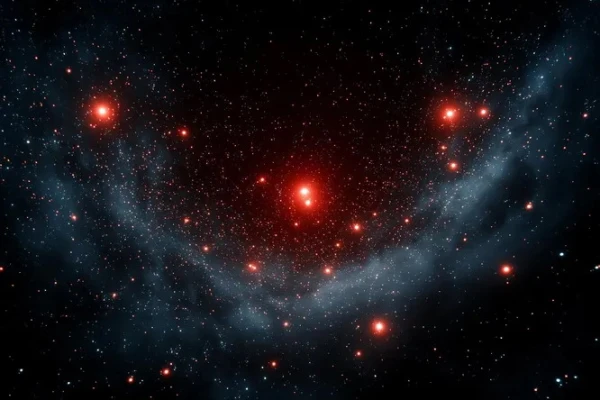
Professor Enrique Gastanaga from the University of Portsmouth presented a bold hypothesis about the nature of the mysterious "little red dots" discovered by the James Webb Telescope. He suggests that these ancient objects, appearing hundreds of millions of years after the Big Bang, may not just be early galaxies, but relics of a preceding Universe, challenging our understanding of its birth.
Professor Enrique Gastanaga, a leading specialist from the Institute of Cosmology and Gravitation at the University of Portsmouth, has proposed a completely new, intriguing interpretation of the mysterious "little red dots." These objects, first observed by the powerful James Webb Space Telescope, date back only a few hundred million years after the Big Bang, which in itself is a striking fact.
According to the researcher, these seemingly tiny formations are actually colossal galaxies, whose stellar populations are comparable to our Milky Way. Their existence at such an early stage in the history of the Universe literally overturns established cosmological models, leading some astronomers to nickname them "universe destroyers."
A Bold Hypothesis: The Universe as a Pendulum
Gastanaga suggests that these incredibly advanced galaxies serve as compelling evidence for a completely different nature of the beginning of the Universe. He believes that the Big Bang was not a one-time event, but rather a recurring "Big Bounce."
The "Big Bounce" model offers a radically different perspective on the origin of the Universe compared to the classical picture. According to the standard theory, the Universe was born from an infinitely dense singularity, after which its expansion began, and before that moment, essentially, nothing existed.
However, the concept of "bouncing" paints a cyclical picture: the Universe expands infinitely, then, under the influence of gravity, begins to contract, striving for an ever smaller volume. But instead of collapsing into a singularity and disappearing, it reaches a certain critical density threshold and "bounces," transitioning from contraction back to the expansion phase.
As the scientist noted in his description for The Conversation, in such a model, the Universe undergoes a phase of contraction, but then, instead of collapsing into a singularity, it "bounces" and begins a new phase of expansion. In this majestic cosmic cycle, according to Gastanaga, special objects drift like eternal buoys, which he called "relic black holes."
Relic Black Holes: Survivors of Catastrophe
The scientist's argument is based on the idea that such super-dense clumps of matter possess sufficient stability not to be absorbed when compressed to the epicenter of the "bounce." The theoretical foundation for this is provided by the Pauli exclusion principle, discovered a hundred years ago by Wolfgang Pauli and still used to explain the formation of neutron stars.
The subatomic pressure of degenerate neutron gas prevents the collapse of certain supermassive stars into even denser black holes. Gastanaga suggests that a similar mechanism could protect relic black holes from complete destruction.
According to his calculations published in the February issue of Physical Review D, a number of cosmic objects exceeding 90 meters in size could survive the "bounce" and remain as relics. These include black holes, gravitational waves, and density fluctuations.
The researcher also considers another pathway for the formation of relic black holes. When enormous dispersed halos of matter and surviving galaxies come under the compressive force of the next cycle of the Universe, they may collapse into a black hole, which then successfully resists further attraction to the "bounce" point.
Dark Matter: A New Explanation
If the mechanisms for the formation and preservation of such objects are sufficiently widespread, there should be significantly more of them than those we see in the centers of the "red dots" observed by the James Webb Telescope. The combined mass of countless single, hidden, or lost relic black holes could well explain the gravitational effects that physicists traditionally attribute to mysterious dark matter.
Gastanaga called relic black holes a compelling alternative to existing dark matter models. If the "bounce" indeed generates them in vast quantities, they could constitute a significant, and possibly dominant, portion of all dark matter in the Universe.
Many astrophysicists still hope that dark matter will turn out to be a fundamental particle, evenly distributed throughout the cosmos; candidates include dark photons, axions, and weakly interacting massive particles (WIMPs). However, in the absence of definitive evidence, experts are actively searching for alternative hypotheses, including those related to black holes.
One such idea is the search for tiny primordial black holes, which are conceptually close to the relic objects proposed by Gastanaga. The scientist himself acknowledged that there is still a huge amount of work to be done, but the prospect that the Universe did not arise just once, but made a "bounce," and that modern dark structures of galaxies are relics from the pre-Big Bang era, opens truly profound horizons for cosmology.















Leave a comment