
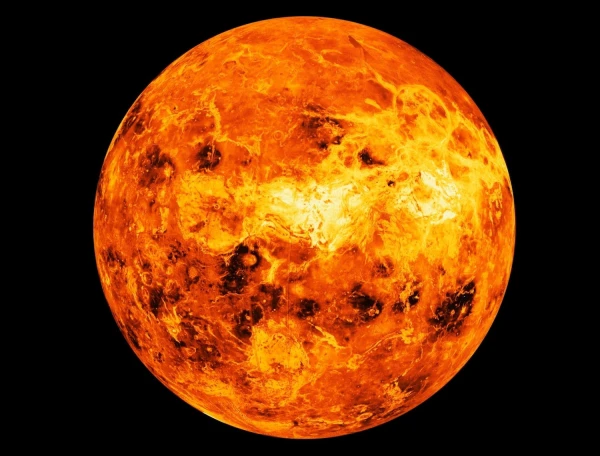
A new study suggests that billions of viable Earth cells could have made an incredible journey to Venus, radically changing our understanding of potential life in its mysterious clouds.
Panspermia, an intriguing theory, claims that life is capable of traveling through the vastness of space, being transported on asteroids, comets, and other celestial objects. When the "building blocks" of life emerge on one planet, powerful collisions can eject particles from its surface directly into space, becoming the "seeds" for other worlds.
For many years, scientists have actively discussed the likelihood of such exchange between Earth and Mars, in both directions. However, recent heated discussions about the possible existence of microbial life in the dense Venusian clouds have significantly expanded this dialogue, incorporating interplanetary transfer between Venus, Earth, and Mars.
The Mystery of Venusian Life
At the recent 2026 Lunar and Planetary Science Conference (LPSC), a team of researchers from the Johns Hopkins University Applied Physics Laboratory and Sandia National Laboratories presented their in-depth investigations into this bold hypothesis. They utilized the "Venus Life Equation" (VLE), developed by Noam Eisenberg and colleagues in 2021.
The modeling conducted by this group predicts something astonishing: life could very well exist in the clouds of Venus for at least a few days per century, aided by materials ejected from Earth. Similar to the famous Drake Equation, the VLE breaks down the overall probability of life into several key factors.
The mathematical formula of the Venus Life Equation (VLE) is as follows: L = O x R x C. Here, L represents the probability of life currently existing (from 0 to 1, where 0 means no chance at all and 1 means absolute certainty). O is the chance of life emerging and successfully establishing itself on Venus. R represents the resilience of the biosphere, its ability to exist and adapt to changes, while C refers to continuity, meaning the probability of maintaining habitable conditions up to the present day.
Survival in Space Travel
Applying this framework, the researchers first examined how any organic material, regardless of its origin, would have to survive the perilous journey through space. In addition to the powerful impact and traumatic shock, it faces intense heat, extreme temperatures, lethal radiation, and the relentless vacuum of outer space.
Fortunately, both computer modeling and analysis of meteorites found on our planet convincingly demonstrate that organic substances are quite capable of withstanding both ejection from the surface and subsequent interplanetary transfer.
Upon reaching Venus, organic material must be dispersed directly in its clouds or above them to have any chance of survival. Considering this crucial factor, the team focused their calculations on the behavior of bolides – bright meteors – as they enter the Venusian atmosphere.
They accounted for ablation, explosion, and subsequent fragmentation of bolides into tiny particles capable of floating in the clouds. To model this process, the scientists applied the so-called "pancake model" – a widely used semi-analytical method that excellently describes the fragmentation process of a bolide as it passes through the atmosphere.
When a bolide spectacularly explodes in the atmosphere, creating an "airburst," aerodynamic resistance rapidly disperses its fragments horizontally. This creates a characteristic "pancake" of scattered material, which the researchers metaphorically refer to as "cells."
Using this "pancake model" and data from previous works to determine the values of the first two parameters, the team carefully calculated the total number of bolides that could have been delivered to the clouds of Venus from both Earth and Mars. Based on these calculations, they discovered something remarkable: hundreds of billions of "cells" could have been transported from Earth to the Venusian clouds, and hundreds of millions of them could very well have retained their viability!
Incredible Numbers and Prospects
However, according to the most accurate estimate obtained from their model, around 100 such "cells" are dispersed in the clouds of Venus each year. Over the last billion years, as many as 20 billion cells could have been transferred from Earth to Venus!
Although the researchers honestly acknowledge that their model does not encompass all the nuances of a bolide's interaction with the atmosphere, and each parameter of the VLE, like the Drake Equation, carries significant uncertainty, it clearly demonstrates the possibility of panspermia between Earth and Venus. Therefore, if future astrobiological missions do indeed find signs of life in the mysterious clouds of Venus, there is a real chance that this life originated on Earth and made an incredible cosmic journey.










Leave a comment