
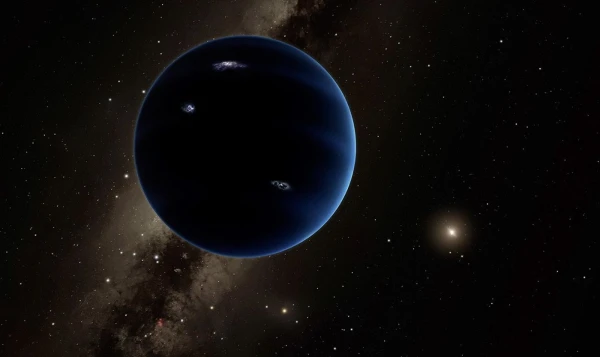
After Pluto was stripped of its planet status in 2006, we have come to consider our Solar System to consist of eight celestial bodies. However, some astronomers are convinced of the existence of the mysterious Ninth Planet, and thanks to the latest powerful telescope, its discovery may become a reality in the near future.
Since 2006, when Pluto was reclassified, we have been constantly reminded of the eight planets in our system. However, many scientists are actively discussing the possibility of a ninth planet, and a modern powerful telescope may finally unveil this mystery. Starting in 2025, the Vera C. Rubin Observatory in Chile will begin operations, promising to radically change our understanding of the cosmos. Among its tasks is to explain a number of unexplained phenomena in the vicinity of the Solar System.
The question of the Ninth Planet has sparked heated debates in the scientific community since 2016. It was then that astronomers Konstantin Batygin and Michael Brown from the California Institute of Technology (Caltech) presented a paper proving the existence of a massive planet on the outskirts of the Solar System. According to their calculations, its mass is about 10 times that of Earth. Scientists believe that only such a large celestial body can explain the strange behavior of six distant trans-Neptunian objects (TNOs).
These objects orbit the Sun in the Kuiper Belt at much greater distances than Neptune. Their orbits are unusually tilted and elongated, indicating possible gravitational influence from a larger neighbor. Professor Brown emphasized to the BBC: "If the Ninth Planet does not exist, then we have no explanation for many strange phenomena."
The irony of the situation is that Brown was a key figure in the decision to strip Pluto of its status as the ninth planet 20 years ago. Pluto, discovered in 1930, was considered the smallest and most distant planet until the early 21st century. In 2005, Brown and his colleagues discovered Eris, a Pluto-sized object orbiting beyond Neptune. This discovery led to a revision of the definition of a planet by the International Astronomical Union in 2006, and Pluto, along with Eris, was reclassified as a dwarf planet.
Strange, Dim, and Distant
The main hitch in the search for the Ninth Planet is that no one has seen it yet, at least officially. Batygin and Brown, for example, based their conclusions on computer models. This is because the hypothetical Ninth Planet, if it exists, is located very far away.
According to estimates by astronomers at Caltech, on average it is located 20 times farther from the Sun than Neptune. One orbit around the Sun for the Ninth Planet could take up to 20,000 Earth years. An object at such a distance reflects very little light, making it extremely dim.
The situation is complicated by the unusual orbit of the Ninth Planet, according to scientists' calculations. Unlike the nearly circular orbits of the eight known planets, its orbit is likely to be highly elongated and tilted. However, we may soon finally be able to see the Ninth Planet.
Powerful telescopes of the past, such as the James Webb, were designed to study specific objects in deep space. But the Vera C. Rubin Observatory will scan the entire sky of the Southern Hemisphere every few nights. It is expected that over 10 years it will catalog billions of cosmic objects, including more than 40,000 new TNOs.
Astronomer Sarah Greenstreet, who works at the observatory, says: "Rubin can find many objects in space that are much dimmer and much farther away than we have ever been able to see." She is confident: "If the Ninth Planet exists where it is supposed to be, and its size matches the hypothesis... Rubin will find it."
A Repeat of the Neptune Story?
Brown also believes that the Rubin Observatory "will either find the Ninth Planet itself or find undeniable evidence — or refutation — of its existence." In his opinion, the planet could be discovered within the next year or two. This would be a monumental discovery. Brown states: "The Ninth Planet could become the fifth largest in our Solar System and the first discovered in 180 years!"
The astronomer recalls the official discovery of Neptune in 1846. Its existence was predicted after scientists noticed anomalies in Uranus's orbit. Then, German scientist Johann Gottfried Galle used the calculations of his colleagues to find Neptune in the sky. Interestingly, Galileo Galilei observed Neptune as early as 1612 but could not identify it as a planet because its movement was too slow for the telescopes of the time.
Could history repeat itself with the Ninth Planet? Astrophysicist Malena Rice from Yale University believes it is quite possible. She says: "I am not at all convinced that the Ninth Planet is not in the data we have already obtained. We just need to study it very carefully."
The Most Typical Size in Other Systems
This is perhaps what a group of scientists from Taiwan, Japan, and Australia managed to do in April of last year. They analyzed old sky surveys from two infrared telescopes taken in 1983 and 2006 and discovered a pair of identical dim points that may indicate the movement of an unknown planet. Some astronomers have reacted skeptically to their finding, and the researchers themselves are very cautious in their conclusions.
Terry Pan from Taiwan's National Tsing Hua University admits: "It is too early to say that we have found the Ninth Planet." He prefers to call it the discovery of a "potential candidate" for the role of the Ninth Planet. For astronomers like Rice, confirmation of the existence of the Ninth Planet would not be a surprise.
The hypothetical planet is estimated to be larger than Earth but smaller than Neptune. Rice notes that planets of this type are the most common in other star systems. She explains: "We see planets of this kind around about half of the stars, yet there are none in the Solar System."
If Not a Planet, Then What?
Opponents of the Ninth Planet hypothesis present various arguments, from possible observational errors in the work of Batygin and Brown to historical examples of erroneous theories about mysterious planets. For instance, in the early 20th century, scientists suggested that Planet X influenced Uranus's orbit, but this theory was later disproven. Sarah Greenstreet from the Vera C. Rubin Observatory notes that in recent years, evidence for the existence of another planet has been dwindling.
But even if the observatory does not confirm the existence of the Ninth Planet, the researcher remains optimistic. She says: "There is a vast region in the outer Solar System that is still almost unexplored... who knows what awaits us there."













Leave a comment