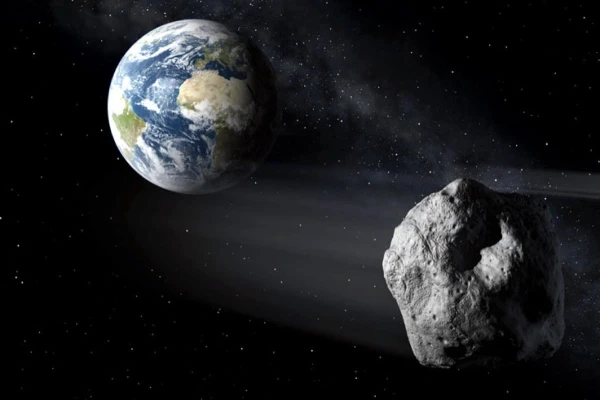
Discovered more than two decades ago, asteroid 99942 Apophis, named after the ancient Egyptian god of chaos, has raised serious alarm from the very beginning. It was recognized as one of the most dangerous objects potentially threatening Earth with a collision. Special concern was raised about the date April 13, 2029, when its trajectory could intersect with our planet.
Asteroid 99942 Apophis, discovered more than two decades ago, was named after the fearsome ancient Egyptian god of chaos, darkness, and fire. It is a true relic of the early Solar System, with an estimated age of about 4.6 billion years. This cosmic wanderer is made of primordial material that has never been part of planets or their satellites.
According to NASA, the average diameter of Apophis is an impressive 375 meters. Its surface has been subjected to constant exposure to the space environment for billions of years, including aggressive solar winds and cosmic rays.
From Threat to Unique Event
Immediately after its discovery in 2004, Apophis raised serious concerns as its trajectory predicted a possible collision with Earth in 2029, 2036, or 2068. Fortunately, subsequent, more precise observations completely changed this alarming assessment.
In 2021, NASA officially removed Apophis from the list of potentially hazardous objects for our planet for the next 100 years. This was a relief for the entire world, but interest in the asteroid has not diminished.
The Incredible Close Encounter of 2029
Despite the removal of the collision threat, on April 13, 2029, we will witness an incredible event: Apophis will fly by at a record close distance from Earth. It will be only 32,000 kilometers from the surface of our planet.
This is simply astounding: nearly 12 times closer than the average distance to the Moon, and even closer than the orbits of many geostationary satellites! Such an unprecedented close approach will go down in history as one of the closest observations of objects of this size. NASA has classified it as a "very rare event."
Astronomers unanimously state that the flyby will be completely safe for us. Although Earth's gravity will certainly alter the asteroid's orbit around the Sun slightly, making it a bit wider, the risk of collision will remain zero.
What Happens After?
After its grand flyby in 2029, Apophis will join the group of Apollo asteroids. This means it will cross Earth's orbit, but its own trajectory around the Sun will become slightly wider.
This event will provide a unique opportunity for observations: in good weather, the asteroid will be visible to the naked eye in the night sky of the Eastern Hemisphere, covering Europe, Africa, and Asia!
Space Agencies Prepare
Leading space agencies around the world will certainly not miss the chance to "greet" this interplanetary wanderer up close. NASA's OSIRIS-REx probe is already heading toward it after a successful visit to the asteroid Bennu.
Additionally, the ESA RAMSES probe is being urgently developed, with a launch planned no later than 2028. There are rumors that Chinese scientists are also preparing their spacecraft, although there is no official information yet. Thus, our Earth is actively preparing for these exciting "gravitational embraces" with Apophis. It will be a truly unforgettable spectacle and an invaluable experience for science. The continuation of this cosmic story is sure to follow!