
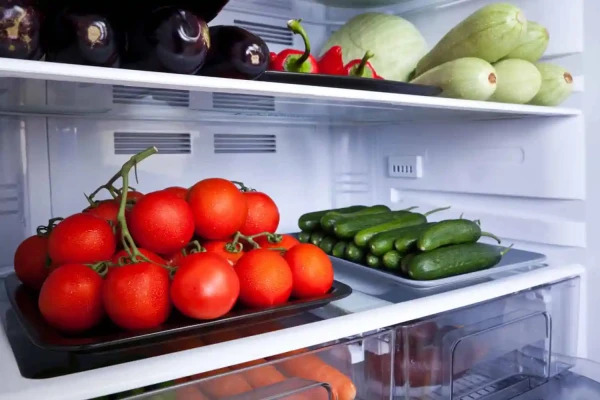
In spring, fresh greenhouse vegetables appear on the shelves, but within a day they can start to lose their appearance: cucumbers become soft, and tomatoes become wilted. The reason is that such products require special storage conditions.
What is special about greenhouse vegetables
Cucumbers, tomatoes, peppers, greens, and salads have a thin skin and high moisture content. Because of this, they do not tolerate cold well and respond more quickly to changes in temperature and humidity.
Temperature is the main factor
Unlike root vegetables, greenhouse vegetables do not like extreme cold.
Tomatoes are best stored at a temperature of about +8–12 degrees — for example, on the refrigerator door or in a cool place.
Cucumbers feel comfortable at +10–12 degrees, and at lower temperatures, they can become watery and lose their flavor.
Peppers prefer a range of +8–10 degrees.
Greens and salads, on the other hand, need a lower temperature — around 0–2 degrees, but with high humidity.
When these conditions are violated, so-called cold damage occurs: vegetables darken, become soft, and lose their aroma.
Why humidity is important
For most greenhouse vegetables, an optimal humidity of 85–95% is ideal, and for greens, even higher.
In dry air, products quickly lose moisture: cucumbers shrivel, greens wilt, and tomatoes become soft.
The best way to maintain balance is to use paper packaging or bags with holes that retain moisture but allow vegetables to "breathe."
When the refrigerator is harmful
The habit of storing everything in the refrigerator is not always justified. Too low a temperature worsens the structure of vegetables:
-
cucumbers become "glass-like,"
-
tomatoes lose flavor and aroma,
-
peppers lose density.
Therefore, it is better to choose either a cool place or the "warm zones" of the refrigerator.
Dangerous neighbors
Many fruits emit ethylene — a gas that accelerates ripening. For delicate vegetables, this means accelerated spoilage.
Especially undesirable combinations:
-
tomatoes next to apples,
-
cucumbers with any fruits,
-
greens next to bananas.
Such proximity can shorten the shelf life to one or two days.
How to extend freshness
-
Do not wash vegetables in advance — moisture accelerates bacterial growth.
-
Remove them from airtight bags to avoid condensation.
-
Try to avoid temperature fluctuations.
-
Do not leave vegetables in direct sunlight or near the stove.
-
Use refrigerator zones with adjustable humidity or store products in a cool place.
Conclusion
Greenhouse vegetables spoil faster not due to quality, but due to improper storage. By maintaining the temperature regime, monitoring humidity, and avoiding proximity to fruits, their freshness can be preserved significantly longer.














Leave a comment