The formation of such worlds is a fairly common process.
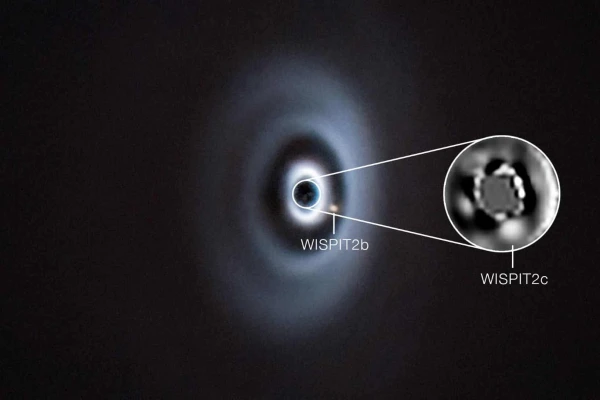
In the gap of the protoplanetary disk of the star WISPIT 2, scientists have discerned a developing planet. This is already the second giant in this forming "family," making it extremely similar to the young Solar System.
In 2025, as part of the WISPIT survey, astronomers noticed a protoplanetary disk around the young star TYC 5709-354-1, divided into several rings, and in one of its gaps — a forming protoplanet. The star was named WISPIT 2, and the planet — WISPIT 2b.
The young star WISPIT 2 is a Sun-like T Tauri star about five million years old. It is located 437 light-years away from us. WISPIT 2b is a gas giant five times more massive than Jupiter and a thousand times younger than Earth. It has "cleared" its orbit in the protoplanetary disk at a distance of about 57 astronomical units from the star. For comparison, Neptune orbits at 30 astronomical units from the Sun.
In the first images, it was immediately clear that the large protoplanetary disk of WISPIT 2 is broken into at least four rings. This became the main distinguishing feature of WISPIT 2 from other young systems where a forming planet has been discerned in the disk. Generally, gaps in disks can arise from internal gravitational interactions, but scientists still hoped to find at least one more planet there — and they were right.
Using the SPHERE and GRAVITY+ instruments of the VLT telescope in the WISPIT 2 system, scientists identified another giant — WISPIT 2c. The new forming planet is twice as massive as its neighbor and is four times closer (15 AU) to the star. The scientific paper describing the discovery has been published in The Astrophysical Journal Letters.
Judging by the number of confirmed exoplanets, the formation of such worlds is a fairly common process. The problem is that spotting a tiny point-planet in a dust-gas disk is very difficult. To date, scientists have found only a few disks with emerging worlds, including PDS 70, AB Aur, and HD 169142.
For a long time, PDS 70 remained the only such system with two confirmed planets. Now WISPIT 2 has been added to it. Both are similar to the young Solar System.
"WISPIT 2 is the best we have right now to glimpse our own past," explained the lead author of the new study, Chloe Lawlor.
In both systems, the protoplanets formed where they are at the time of observation, rather than migrating from other orbits. This will allow for the study of the parameters of the protoplanetary disk that contribute to the birth of worlds. Researchers have already dubbed such conditions a potential "Goldilocks zone" for giant planets. In the WISPIT 2 disk, there is another promising gap far from the star. The authors of the new work suspect that a third planet "resides" there, likely the size of Saturn, since the gap is small. The Extremely Large Telescope, scheduled to launch in 2029, will be able to take a picture of this exoplanet. Meanwhile, scientists will continue to observe the system with available tools.