
Next year, exercises are set to take place in low Earth orbit involving new super-maneuverable satellites.
From April 1 to 6, the SLS rocket is set to launch with four astronauts on board who, if all goes according to plan, will orbit the Moon. This will be the third launch attempt: the previous ones in February and March were canceled due to technical issues.
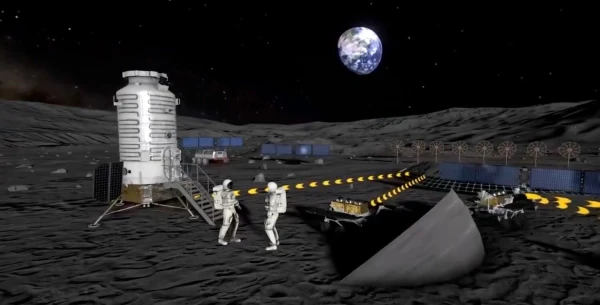
But the Americans are not the only ones aiming for the Moon. China has become the main competitor in the lunar race, the prize of which will be the ability to mine helium-3 there — fuel for thermonuclear reactors. This is the holy grail for all energy producers. The PRC is actively developing and testing a rocket, a crewed spacecraft, a cargo ship, and a lunar lander for its lunar mission. An International Scientific Lunar Station is expected to be established in the 2030s.
No matter how you look at it, the Americans and Chinese will have to work in close proximity. And it won't be possible to reserve a spot in advance. The 1967 Outer Space Treaty directly prohibits the appropriation of territory on celestial bodies. Therefore, there are no guarantees that competitors will not decide to explore the same, most attractive and convenient area of the Moon.
Questionable Safety
The potential proximity of competitors raises concerns at the state level. This issue was raised at a seminar between the U.S., Australia, and the UAE (all partners in the Artemis lunar program) during the International Astronautical Congress (IAC) in Sydney. Two important questions were formulated there, to which there are currently no answers.
Firstly, it is unclear how to interact with competitors if someone encounters an emergency. Any chance to leave the Moon and save lives is of great value. But there is no dialogue on this topic with China or Russia, which is also involved in the project to create the International Scientific Lunar Station. This is how politics affects the safety of people even on the Moon.
Starship HLS
Chinese landers are incompatible with the developments of American SpaceX and Blue Origin. Photo: SpaceX
Secondly, the Artemis agreements provide for the creation of buffer zones around landing and living modules, as well as mining sites. Formally — to exclude "harmful interference." But there is currently no understanding of how large these buffer zones should be, nor a definition of what constitutes "harmful interference."
What should be done if China suddenly violates the boundary of the buffer zone? The interpretation of this definition carries special risks. There is currently no clear wording, but if buffer zones grant something akin to property rights on the Moon, then the PRC and Russia may interpret this as territorial claims and a violation of the Outer Space Treaty. This could lead to a direct conflict.
How the U.S. Will Fight China in Space
America has already begun preparing for real space battles. Next year, exercises are set to take place in low Earth orbit involving new super-maneuverable satellites that can locate, chase, and pursue enemy satellites.
But this will be a battle of automated satellites, unmanned vehicles. On the Moon, things are more complicated — there are living people. If you want to know how this might end — watch the American comedy series "Space Force" from 2020. In the finale of the first season, a similar situation occurs: the U.S. sends astronauts to the Moon, but it turns out that Chinese taikonauts arrived there first and claimed the same spot for themselves.
Jackal Satellites
To practice low Earth space battles, the U.S. will use the Jackal satellite. Photo: True Anomaly
American astronauts are ordered to sabotage the operations of the Chinese base — they go out to destroy the competitors' equipment. In response, the Chinese break the American landing module. In the end, everyone finds themselves in a stalemate with no way to fly back to Earth. Yes, this is comedic grotesque, but the emergence of such a conflict cannot be ruled out.
The Peaceful Path Is the Most Difficult
Theoretically, America and China could preemptively prevent a potential conflict by agreeing on zones for lunar exploration. However, in 2011, the U.S. passed a law that prohibits cooperation between NASA and the China National Space Administration (CNSA). All to prevent the Chinese from acquiring American technologies. Because of this, American scientists could not pay for and receive lunar soil samples from the PRC, delivered by the Chang'e-5 spacecraft.
The American authorities consciously chose a path of isolation from Chinese competitors. Therefore, the winner will be the one who first occupies a winning position on the Moon. The lagging party will either have to endure inconveniences or go into conflict, establishing themselves nearby.










Leave a comment