
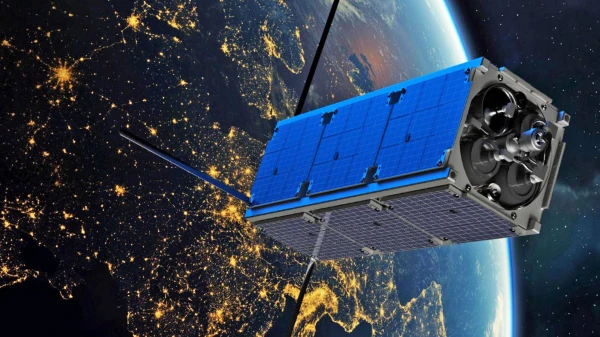
The development and preparation took about 1000 days.
16 satellites of the low-orbit group "Rassvet" were placed into orbit by the Russian aerospace company "Bureau 1440." The devices successfully separated from the launch vehicle and were transferred to the control of the flight control center.
The launch marked the first batch deployment of devices as part of the formation of a target satellite network. After separating from the rocket, the satellites underwent transfer to the control center and will begin subsequent maneuvers to reach their designated orbits. The devices are built on the company's own platform and are equipped with a communication system based on 5G NTN architecture. They utilize upgraded power systems, next-generation inter-satellite laser communication terminals, and plasma engines. The company’s developed separation system was also applied.
According to industry representatives, the launch of the first satellites signifies a transition from the experimental phase to the establishment of a full-fledged communication service. The development and preparation took about 1000 days — that is how long it took from the launch of the test devices to the deployment of the serial ones.
Further deployment of the group will require dozens of launches and an increase in the number of satellites in orbit. The company notes that this is a complex technological process with a number of engineering risks; however, such systems are viewed as the foundation of future global data transmission infrastructure.
"Bureau 1440" is part of the ICS Holding and is engaged in the creation and operation of a satellite group to provide high-speed connectivity with global coverage. Its own enterprises and a team of more than 3,000 specialists are involved in the development and production. Commercial operation of the broadband satellite communication service is planned to begin in 2027, with the first tests with clients scheduled for 2026. To ensure continuous coverage 24/7, more than 250 devices are planned to be launched into orbit.












Leave a comment