
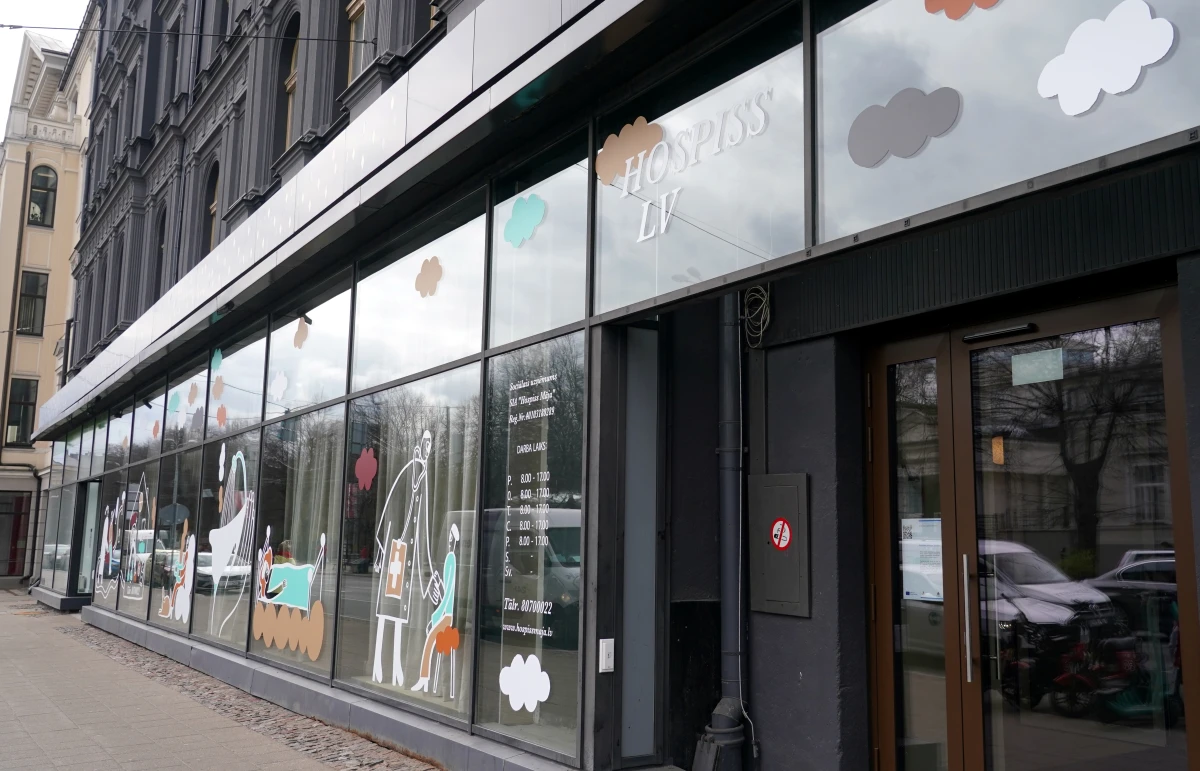
At the end of April, the first day hospice care center in Latvia opened in a historic building on Brivibas Boulevard, where the "Sakta" store operated for many years.
It Turned Out Symbolic
On one hand, it’s great – in the establishment created with the support of the Society Integration Fund, patients will be able to receive services from palliative doctors and nurses, water treatments, psycho-emotional support, as well as spend time with trained volunteers.
On the other hand, it’s an uncomfortable symbol. A symbol of an aging, suffering society located between the main monument and the government of the country. In the building that, in prosperous years, was the main fashionable showcase of consumption and where life thrived.
The services of the center can be used by people who have been given no more than six months to live by a doctor. For a fee. And for a group of 10 people. The price list could not be found on the website, but there is an intriguing section called "Death Cafe". It’s hard to come up with a more absurd and sinister name. It’s suitable for a horror movie.
Grand Nonsense
Of course, such a form of psycho-emotional support was conceived by young people, who rarely think about the fact that they too will one day have to ponder the eternal. And they probably believe that people on the edge of life are very eager to chat about death. Although many of them have long stopped talking at all.
They say that Death Cafes have long been popular abroad. The movement even has a beautiful slogan: "We talk about death to change life." Grand nonsense.
The website explains: during meetings at the "Death Cafe," people can discuss their understanding, thoughts, dreams, fears, and all other aspects of death and dying. There are also events that allow specialists in the field of medicine and healthcare to talk about death.
A Narrow Strip of Light
Usually, about 12 people gather in a group for discussion, and the meeting lasts two hours. Tea and pastries are important components of the event, helping to create a favorable atmosphere. And how much does a glass of vodka cost in your cafe? After all, many talk about death only after a drink. Or is it covered by the integration fund? And what do these gatherings even resemble? Spiritualist sessions? Dances for the elderly? An anonymous alcoholics meeting? Like, here I am, Janis Pupkins, I planted a tree, raised a son, and burned down the house, so I lived in vain.
Or is it more of a philosophical circle? Where they quote, say, Nabokov: "Drowning out the whisper of inspired superstitions, common sense tells us that life is just a narrow strip of light between two perfectly black eternities." Brrr, this already sends a chill of the grave.
Or Schopenhauer, who, as a psychoanalyst, probes the patient – why are we horrified by the impending nothingness after life, if we are not afraid of the nothingness that preceded it?
A Good Religion Was Invented by Indians
Or from the perspective of Buddhists, there is certainly enough to discuss. Imagine, if in this life you were a misogynist and hurt women, then in the next you might be born a girl somewhere in a patriarchal bear corner. And if you were an orthodox Jew, you would be born a Muslim. And so on, even as a shaved nutria.
Buddhists believe that you are given countless lives to ultimately free yourself from obstructive feelings and achieve enlightenment. To break through the finish line, ending the cycle of rebirths amidst the cheers of your previous incarnations.
But not so fast. Most likely, the death cafe was conceived by atheists:
Death Cafe is not a religious and, even more so, not a church event, so there is no dominant theme that would overshadow other aspects of death. At the meetings, any facets of death are discussed, and any viewpoints are allowed. The events allow cafe participants to rethink their birth, life, and death, freeing all of this from systemic doctrines.
So what should I talk to you about? As a believer, I do not want to free the topic from doctrines. It would be easier for me if I could fully believe in HIS MERCY. In the belief that He will forgive me my transgressions, including this note.
On the other hand, I admit I was wrong – the center for the dying on Freedom Street and near the Freedom Monument is a good, correct, and even quite religious symbol.



Leave a comment