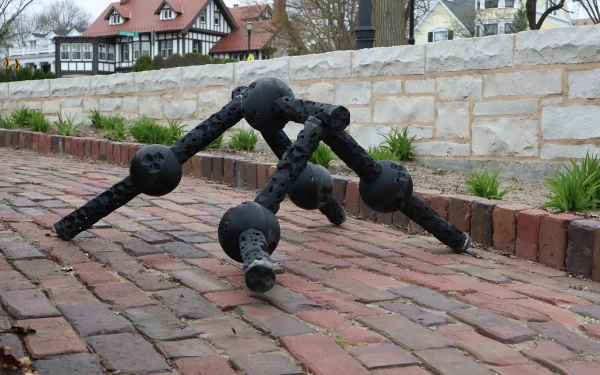
The highlight of the project is that the design was developed by a neural network.
Researchers from Northwestern University (Illinois, USA) demonstrated how AI can conduct the "evolution" of robots in just a few minutes. Their development is a strange modular robot that can continue moving even after severe damage.
Ordinary robots are tailored for specific conditions: warehouse robots for flat concrete, "robot dogs" for stairs. Outside of predefined scenarios, they often become useless: a fast robot in the field can get stuck in mud or stop when it loses a limb.
The team took a different approach: instead of trying to anticipate all situations, they built a robot that changes its configuration and mode of movement "on the spot." The result is a "walking metamachine": a rough but resilient robot that, according to the authors, can function even after being cut into pieces.
It consists of modules resembling Lego parts. Each module is a mini-robot with a battery, motor, and computer. The design is simple: a sphere in the center and two "arms/legs" that rotate around a single axis. One module can roll, tumble, and jump. When assembled, the modules, exchanging data, crawl, jump, roll, and move in a "wavelike" manner — chaotic in appearance but effective: the system does everything to get from point A to point B.
"Indestructibility" is a consequence of modularity: if a part falls off or is damaged, the others find a way to continue moving. In outdoor tests, the robot traversed grass, gravel, and mud, maintaining its movement even after losing a whole "leg."
The highlight of the project is that the design was developed by a neural network. The scientists provided it with "building blocks" (modules) and a goal — the most efficient way of movement. In the simulation, the AI explored thousands of configurations, tested them in extreme virtual conditions, and selected the best ones — based on the principle of natural selection. The final options were then assembled in hardware. The researchers claim this is one of the first "evolved" robots to emerge from simulation into the real world.
So far, the technology is raw: the robot lacks external sensors, it cannot see obstacles, does not build a map, and moves slowly and clumsily. However, the project demonstrates the main evolutionary skill — survival.
<iframe width="560" height="315" src="https://www.youtube.com/embed/kelysQlBnao?si=xPA2wjgzidO85aUQ" title="YouTube video player" frameborder="0" allow="accelerometer; autoplay; clipboard-write; encrypted-media; gyroscope; picture-in-picture; web-share" referrerpolicy="strict-origin-when-cross-origin" allowfullscreen></iframe>