
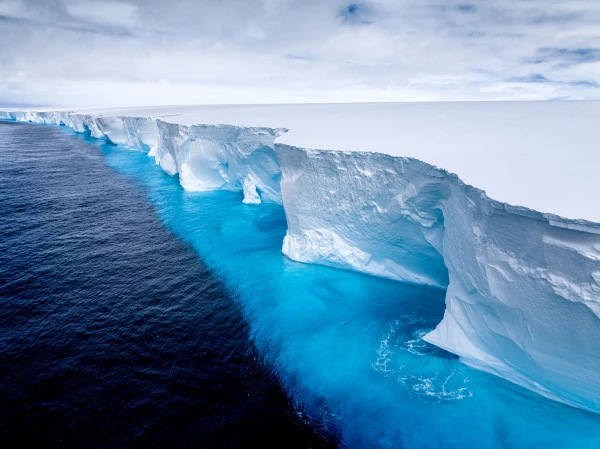
Even at 39 years old, at the beginning of 2025, A23a was still gigantic.
The life cycle of one of the oldest icebergs in the world is coming to an end. For 40 years, it has drifted across the ocean, attracting the attention of scientists.
Not long ago, iceberg A23a was the largest on the planet: its area was more than twice that of Greater London, four times that of Berlin, or three and a half times that of Moscow.
But over the past year, A23a, having drifted far north into warmer waters, has melted, cracked, and majestically broken apart. The warm ocean continues to erode what remains of A23a. Death is near. It has only a few weeks left.
All icebergs eventually melt. But scientists have been particularly closely monitoring the disintegration of A23a, trying to understand what its fate says about how Antarctica is responding to climate change.
"It has lived an amazing life. But now it is in its final days," says Professor Mike Meredith from the British Antarctic Survey.
In Earth's history, there have surely been icebergs that lived longer than A23a, but in modern times, it is considered a record long-liver — at least among those icebergs that scientists have tracked.
"It’s quite an impressive journey, simply by virtue of its duration," says Dr. Christopher Shuman, a former researcher at the University of Maryland. Monitoring this iceberg reminded him of an exciting TV series: "You never know what will happen next."
In the vast expanses of the South Atlantic, it is quite difficult to feel how enormous A23a was. Its stunning dimensions become apparent if you mentally place it, for example, in the English Channel.
Even at 39 years old, at the beginning of 2025, A23a was still gigantic. It could have almost completely blocked the English Channel between the Isle of Wight and Normandy in France. Now it has shrunk to relatively modest sizes: half the width of the strait between Dover and Calais. "It was an exciting sight to watch it last so long and then fall apart in just a year," says Dr. Katherine Walker from the Woods Hole Oceanographic Institution in the U.S. She is the same age as A23a: she was born in the same 1986.
In the first half of 2025, A23a shrank by about a quarter. By mid-year, it had lost its title as the largest iceberg in the world, although it was still very large. Then, in August–September, A23a found itself in the South Atlantic over the Northwest Georgia Rise. This is a mountain on the ocean floor about two kilometers high. It is located approximately 1500 km east of the Falkland Islands.
Above this rise, on a rotating column of ocean water, A23a spun for several weeks. Scientists speculate that this rotation contributed to the iceberg's disintegration, already eroded by the warm ocean waters.
Several large icebergs quickly broke off from A23a, one after another. They were large enough to receive their own designations from scientists, indicating from which iceberg they had broken off: A23g, A23h, and A23i. At the end of December, in the height of summer in the Southern Hemisphere, warm air also hit the iceberg. Bright blue lakes of meltwater, likely several meters deep or more, appeared on it. High edges of the iceberg, known as "ridges," hold them back from flowing into the ocean.
"It’s beautiful, but it’s also a sign that the iceberg is melting from both the top and the bottom," says Meredith. "At that moment, we realized that it had become quite fragile and wouldn’t last long."
"This water on top of the iceberg is trying to seep down," adds Walker. "When it finds cracks, it seeps through them and expands them, leading to cracking and breaking off parts."
This expansion of water-filled cracks, or "hydrofracturing," apparently occurred with A23a in late December and early January.
A collection of small ice debris, known as "melange," near the main iceberg indicates a phenomenon that Shuman describes as a "blowout," caused by the outflow of meltwater from the iceberg.
The melting and breaking apart of large icebergs into pieces is a natural phenomenon, and in this case, it is not necessarily related to climate change — although in some regions of Antarctica, icebergs are breaking off faster than the ice sheet can recover.
Scientists have been closely monitoring the disintegration of A23a also because they wanted to see hints of how rising temperatures will affect Antarctica, especially the ice shelves that extend far into the ocean.
Ice shelves play a crucial role in maintaining the stability of the entire Antarctic ice sheet. However, it is entirely unclear how quickly they will shrink with climate warming and how this will affect sea level rise.
According to Katherine Walker, large icebergs can serve as "floating natural laboratories" that help scientists predict how some of these processes will unfold.
"We can learn a lot by observing iceberg behavior in warmer conditions and overlaying that data onto expected ice shelf behavior," says Dr. Walker.
Over 11 days, from February 11 to 22, the shrinking and losing weight A23a traveled more than 700 km across the South Atlantic, moving northeast at an average speed of about 2.7 km/h.
On this journey, it found itself in warmer waters — nearly 10 degrees at the surface — which did not benefit it. "With each passing day, the water is getting warmer and warmer," says Dr. Christopher Shuman. "It’s like ice in a drink: it disappears very quickly."













Leave a comment