
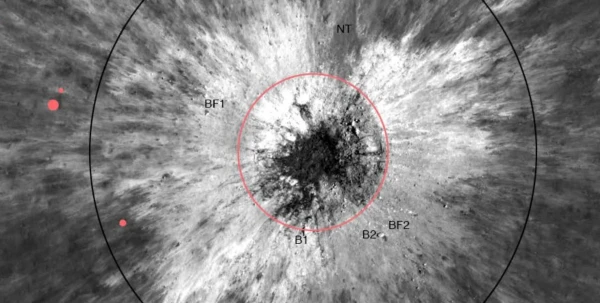
Using data from NASA's spacecraft, a huge new crater has been discovered on the Moon. Its width is 225 meters.
Planetologist Mark Robinson was conducting a standard analysis of images of the Moon's surface, which are continuously taken by NASA's Lunar Reconnaissance Orbiter. As a result, the scientist discovered an unknown crater in the images. Its width is 225 meters, which is larger than the size of two football fields. Calculations show that such craters on the Moon form approximately once every 139 years, writes Focus.
According to Robinson, the new massive crater on the Moon was formed as a result of a large asteroid impact in April or May 2024. Calculations based on other features of the lunar surface indicate that craters of this size, around 225 meters, appear on the Moon once every 139 years.
One of the first new craters on the Moon, discovered by the Lunar Reconnaissance Orbiter after its mission began in 2009, had a width of 70 meters. Robinson says he hoped to find a new crater at least 100 meters wide in the NASA probe data, but ended up finding a crater twice that size.
According to the planetologist, the new crater formed at the boundary between the pockmarked highlands and the broad lunar sea created from liquid lava that accumulated on the Moon's surface.
The depth of the new crater on the Moon is about 43 meters, indicating that the asteroid impact was very strong. The steep edges of the crater suggest that it was created in a solid material, such as solidified lava. However, the shape of the crater is slightly elongated, indicating that the lunar crust beneath it is not entirely uniform, says Robinson.
Surrounding the crater are bright ejecta of rocks and dust that scattered in all directions upon the asteroid impact. These ejecta extend hundreds of meters from the crater, but the farthest effects of the impact are observed at distances of up to 120 kilometers.
This could be bad news for future bases on the Moon. Rock debris ejected as a result of asteroid impacts on the Moon's surface can reach lunar habitation modules at high speeds and from very long distances.
Robinson says that lunar bases need to be designed in such a way that they can withstand encounters with rock debris that may be moving at speeds of 1 km/s.














Leave a comment