
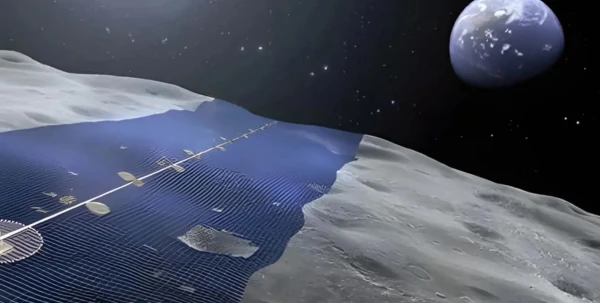
The Japanese company has presented a project to construct a huge ring of solar panels on the Moon, encircling the equator. These solar panels could collect solar energy 24/7 and transmit it to Earth for round-the-clock power supply.
The Japanese company Shimizu has presented a project called "Lunar Ring." A belt of solar panels 11,000 kilometers long, built using lunar regolith, could continuously receive sunlight and transmit up to 13,000 terawatts of clean energy to Earth via microwaves or lasers. This energy transmission could occur around the clock, writes Focus.
Since the Moon constantly receives sunlight, Shimizu proposes to build a solar power plant on the Moon that could generate energy 24/7 and transmit it to Earth.
The project called "Lunar Ring" envisions the construction of a belt of solar panels at the equator of the Moon, 400 km wide and 11,000 km long. The foundation for the solar panels will be built from lunar regolith (soil on the Moon), which can be turned into concrete. The construction of the solar power plant will be carried out by robots.
Using materials already available on the Moon would help avoid the transportation of all the necessary materials for building the "Lunar Ring," which would be very costly. Shimizu stated that the solar panels on the Moon could produce up to 13,000 terawatts of energy and transmit it continuously to Earth. Thus, our planet could receive clean energy in a 24/7 mode. It should be transmitted via microwaves and lasers to receiving stations on Earth.
The cost of such a project has not been disclosed. It is also unclear how the Japanese company plans to deal with lunar dust, which could interfere with equipment operation and cover solar panels.
Shimizu suggests that the construction of the giant lunar power plant could begin as early as 2035, but many details remain unclear.














Leave a comment