
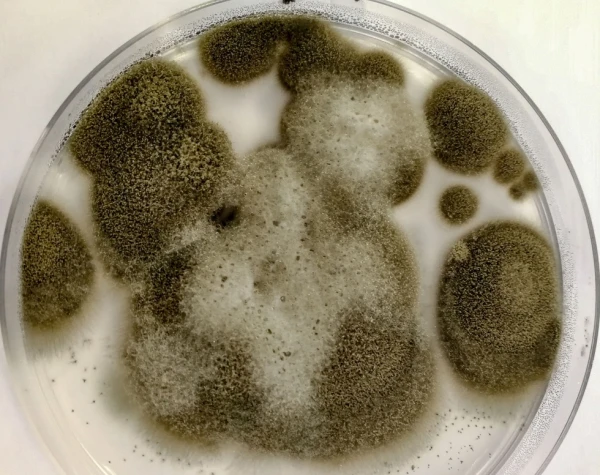
Nearly four decades after the tragedy at the Chernobyl Nuclear Power Plant, in a hazardous zone inaccessible to humans without special protection, nature has not only survived but has astonishingly adapted to the harshest conditions.
Four decades after the horrific disaster at the Chernobyl Nuclear Power Plant, in an area where human access without special protection is strictly prohibited, life has not only survived but has incredibly adapted to extreme conditions. The most astonishing discovery has been the fungus Cladosporium sphaerospermum — a dark, almost black organism found right in the heart of the destroyed reactor.
This unique fungus was first discovered by scientists from the National Academy of Sciences of Ukraine in the late 1990s. Biologists led by Nelly Zhdanova, while examining the walls of the sarcophagus, identified a whole community of 37 species of fungi, many of which exhibited a rich dark coloration due to melanin. Among them, Cladosporium sphaerospermum stood out for its particular resilience and high content of radioactive isotopes.
Later, radiopharmacologist Ekaterina Dadacheva and immunologist Arturo Casadevall, specialists from the Albert Einstein College of Medicine in the USA, established a remarkable fact: the fungus not only does not suffer from ionizing radiation but also shows more active growth under its influence. Their experiments demonstrated that the melanin in the fungus's cells changes its properties under radiation. The scientists hypothesized that this fungus is capable of "capturing" energy from radiation, similar to how chlorophyll in plants converts sunlight during photosynthesis, calling this proposed process "radiosynthesis."
The unusual properties of the fungus received additional confirmation during experiments in 2022, when samples of Cladosporium sphaerospermum were placed on the outer shell of the International Space Station. Sensors clearly indicated that the layer of fungus significantly reduces the level of penetrating radiation compared to a control sample. This discovery prompted scientists to seriously consider the possibility of using such organisms as a natural radiation shield for future space missions.
However, the very mechanism of "radiosynthesis" remains an unsolved mystery. Biologists have yet to find evidence of carbon fixation under radiation or convincing proof of energy acquisition in this manner. Nevertheless, Cladosporium sphaerospermum continues to amaze, serving as a vivid living testament to the incredible ability of life to adapt even to the most lethal conditions.
















Leave a comment