
You need to monitor the battery charge level.
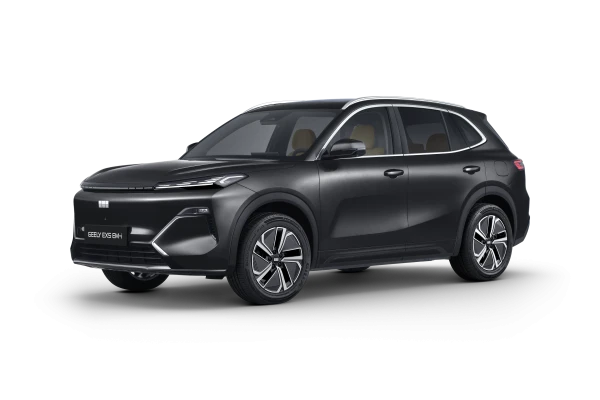
Geely's decision to introduce a hybrid version with the EM-i index following the electric crossover EX5 seems quite logical. Let's try to understand the secret of its success.
In profile and from the rear, the related electric car and hybrid, built on a single modular platform, are virtually indistinguishable. The main differences are at the front: the hybrid has headlights connected by a LED strip, and there is an air intake in the bumper for cooling the gasoline engine's radiator, which the fully electric EX5 lacks.
Additionally, each modification is available in exclusive colors: turquoise for the electric car, and green and blue metallics for the hybrid.
Overall, it is difficult to say which version is more appealing. Both, although lacking bright design flourishes, look modern and neat.
Interior and Trunk
The interior of the hybrid largely replicates the design of the electric modification: a familiar flattened steering wheel, screens for the instrument panel and multimedia system, and a convenient projection on the windshield.
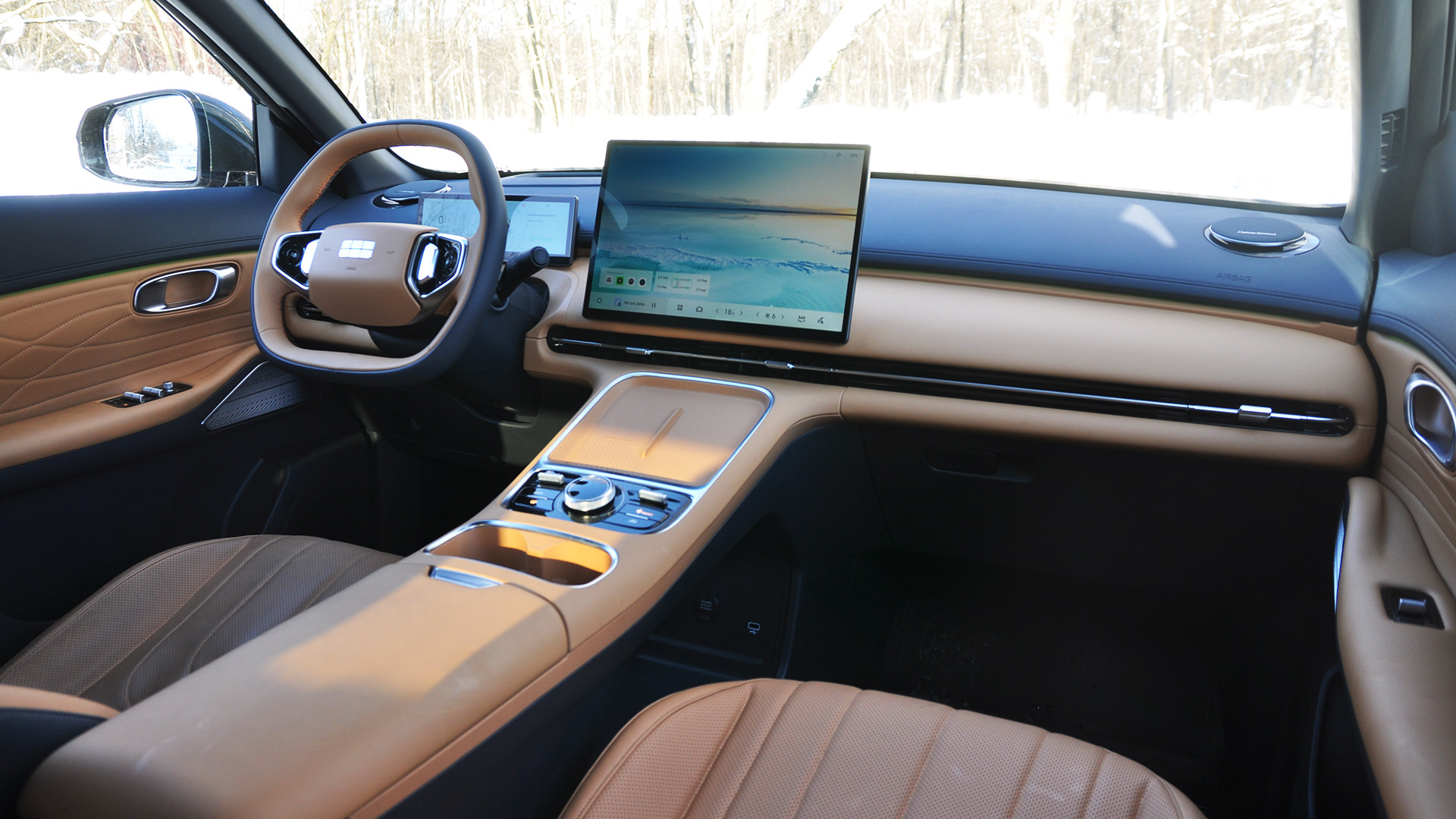
The quality of the finishing materials is also at the same level — the leather, although artificial, is pleasant to the touch. The plastic parts are also well assembled.
The seats, devoid of sporty stiffness, turned out to be surprisingly comfortable thanks to a wide range of adjustments and a successful profile. There are no complaints about visibility and seating comfort.
The multimedia system delights with vibrant graphics and quick responses. The menu is multilayered but logical, so figuring out the functions is not difficult. It was particularly pleasing to have physical buttons on the central tunnel for temperature adjustment and access to detailed climate settings — this allows for less distraction from the road. In the "Energy" section, you can monitor consumption and range, which is especially useful for a hybrid.
However, there were some oddities. The steering wheel heating icon was hidden in the "Seat Comfort" submenu, which is not very convenient. Unfortunately, there is no support for Android Auto despite the presence of Apple CarPlay.
At the same time, second-row passengers have no reason to complain about tightness — even large individuals have enough space for their knees and height. Amenities include two-stage heating, a couple of USB Type A and C ports, and a fold-down armrest with two cup holders.
As for the trunk, it is quite standard for the class: 528 liters to the level of the cover and 2,065 liters with the seats folded down. This is enough for a couple of large suitcases or even for transporting large appliances like a washing machine. The electric tailgate is a nice bonus. However, the trunk is lacking in nets and hooks for small items, and the underfloor space is almost entirely occupied by the charging cable.
How It Drives and How Far
Let's start with the first point — how? With an emphasis on comfort. In both electric and hybrid modes, the car moves almost silently, and the suspension smoothly handles small and medium bumps — and this is on 19-inch wheels.
Yes, the steering does not shine with feedback and feels somewhat synthetic, but the car grips the road firmly, without significant roll or noticeable sway, and the 262 Nm of torque from the electric motor, available from the first turns of the shaft, provides confident acceleration up to 140 km/h. Overall, a solid four.
As for how many kilometers the battery with 18.4 kWh and the 51-liter gasoline tank will last — it completely depends on where and how you will drive, as well as the outside temperature. Let's say right away: we did not achieve the manufacturer's declared 943 km. Our result was 620 km on 10 kWh consumed and 43 liters of gasoline.
This means that for every 100 km traveled, an average of 6.9 liters of fuel and 1.62 kWh of electricity were used. With the price of 95 gasoline at 67 rubles per liter and a kilowatt-hour at 20 rubles, the cost of traveling 100 km amounted to 495 rubles. To compare with a conventional internal combustion engine, we divide this amount by the cost of a liter of gasoline and get an equivalent consumption of 7.4 l/100 km.
It cannot be said that this is an outstanding result — a modern turbo diesel in a similar crossover would likely show less. However, considering the size of the car, a curb weight of 1,845 kg, temperatures ranging from -5 to -15 °C, and the nature of our test, the outcome was rather pleasing.
During this improvised test, we came to several conclusions:
Firstly, it does not matter how much fuel is in the tank. The car maintains brisk dynamics only when the battery charge level is above 25%. If the charge drops below that, the response to the gas pedal noticeably dulls, and at 18%, acceleration becomes quite sluggish. At that moment, the 99-horsepower gasoline engine provides almost all the thrust. Its RPMs soar to 3,000, accompanied by noise in the cabin and consumption approaching 15 l/100 km. In such a mode, a significant portion of energy also goes to charging the battery. Therefore, to maintain acceptable dynamics and consumption within 7–8 liters, the battery charge needs to be kept up. Either recharge at a station or use the forced charging function from the internal combustion engine.
Secondly, even in forced charging mode, if you drive faster than 120 km/h, the battery charge will still deplete. The higher the speed, the faster the discharge. Most likely, on summer tires and in warm weather, the threshold speed will be higher, but the rule remains: if you want maximum range — don’t speed.
Finally, thirdly, at temperatures of -10 to -15 °C, the battery charge after a cold start literally melts away before your eyes. Leave the car overnight with a 25% charge, and after a morning 5 km, it may drop to 20%, again depriving you of optimal thrust. Therefore, in winter, it is better not to let the charge drop below 40%. Another option is to charge the battery at the parking lot from the internal combustion engine, but raising the level by 20% will take about an hour, and during all this time, you will have to sit in the car or exit only through the passenger door — when opening the driver’s door, the engine stalls.
In any case, the very 7.4 l/100 km achieved without special fuel-saving techniques looks very decent in the context of regular use. In summer, consumption would definitely be lower, and when charging from a home outlet at night rates, the cost per kilometer would decrease significantly.
The only significant operational downside of Geely can be considered the discrepancy between reality and the declared fast charging power of 30 kW. At a 60-kilowatt station, when charging a warm battery from 33% to 87%, the peak power did not exceed 18.7 kW. As a result, replenishing 10.5 kWh took 41 minutes. This is a serious drawback for those planning long trips or taxi work with the EX5 EM-i.














Leave a comment