
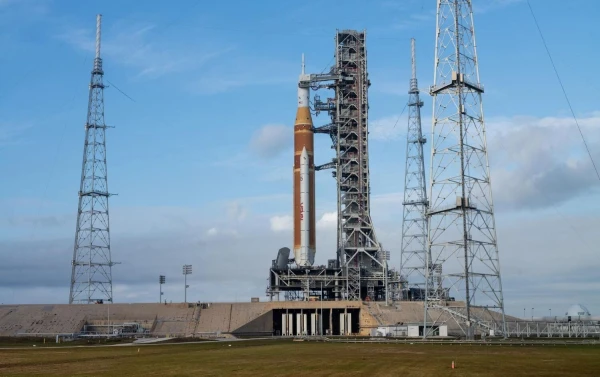
The creation of the SLS has been surrounded by scandals.
The SLS rocket, on which American astronauts were supposed to travel to the Moon, has been returned from the launch pad to the hangar. The crew has been released from pre-launch quarantine: the launch to the Moon, scheduled for early March, has been officially canceled.
The largest and most powerful rocket in the world is constantly plagued by technical problems. The flight to the Moon was initially planned for early February, but during the dress rehearsal on February 2, a hydrogen leak (used as fuel) was detected. A similar malfunction occurred back in 2022 during preparations for the Artemis I mission — at that time, the Orion spacecraft flew around the Moon without a crew. But the creators of the SLS rocket clearly enjoy stepping on rakes.
There was hope that for the first time in 54 years, humans would again travel to Earth's satellite from March 8 to 11: another rehearsal on February 19 went successfully. But on February 21, engineers found problems with the supply of compressed helium — it pushes liquid hydrogen and oxygen into the engines.
NASA reports that "rapid preparation allows NASA to potentially maintain the April launch window" (the journey to the Moon can only occur once a month — otherwise, it takes too long to get there), but such vague and uncertain wording hints that, most likely, the rocket will be repaired closer to May.
The experience of Elon Musk's SpaceX and Jeff Bezos's Blue Origin shows that it is now possible to design and build an entirely new rocket from scratch, packed with modern technologies. Moreover, it would be relatively inexpensive by industry standards.
But the SLS rocket is different — calling it a novelty is a stretch. Boeing decided not to reinvent the wheel but simply took the Space Shuttle system and removed the shuttle itself. The hydrogen tank, main engines, and solid rocket boosters remained the same. The only change was relocating the RS-25 engines from the shuttle to the tank — thus, a classic rocket was created. Everything is old and expensive — each launch is estimated at $4 billion.
All technologies have been tested multiple times; there was no need to create anything fundamentally new. However, from the start of development to the first flight of the rocket, 11 years passed, during which NASA spent $23.8 billion. As of now, the American space agency has allocated $31.6 billion just for the creation of the rocket and launch complex. The Orion spacecraft, which will carry humans to the Moon, has consumed another $16 billion. In total, NASA has spent $47.6 billion on lunar transportation.
This is not just colossal money ($3.65 trillion at the current exchange rate — 11 times the entire budget of Roscosmos for 2026), but also a multiple overrun of the planned budget. In 2011, NASA's leadership expected that the rocket and spacecraft would be ready by 2017, and their creation would require $18 billion.
Years of delays and money going down the drain — all of this closely resembles what has long been happening in Roscosmos. It turns out that we are not the only ones who can inefficiently manage resources.
It is not surprising that the creation of the SLS has been surrounded by scandals. In reports from NASA's Office of Inspector General, there were indications of concealing real expenses and ineffective management, while congressmen are accused of lobbying for the interests of contractors. Because of this, an alternative interpretation of the rocket's name even emerged: not Space Launch System, but Senate Launch System, hinting at the enrichment of senators and other officials as the main goal of the project.
And the case with the SLS is not the only example where bureaucracy triumphs over common sense. Recently, NASA published the results of an investigation into the incident with Boeing's Starliner spacecraft, which caused astronauts Butch Wilmore and Sunita Williams to be stranded on the ISS for nine months instead of ten days. The 312-page publication states that due to bureaucracy and the desire to have a second provider, alongside Elon Musk's SpaceX, to deliver people to the ISS, NASA neglected potential risks. Newly appointed agency head Jared Isaacman added that NASA let the procurement process run its course and did not delve into the development of the spacecraft.
While the new generation of private companies dazzles with technology and achievements, NASA, like the mice in the joke, cries, pricks itself, but continues to chew on the cactus. Only in the role of the cactus is Boeing, which absorbs billions of dollars, time and again. By the way, it is also a private company, just "stuck" to the space agency back in the dawn of astronautics.
After such persistence in choosing contractors, there is even some logic in the position of conspiracy theory supporters who claim that humans have never flown to the Moon, that there is no space, and that all this activity of NASA, Roscosmos, and other similar organizations is just a distraction and a budget cut. We hope that at least in May, the crew of the Orion spacecraft will refute this claim, and humanity will take another step into space.














Leave a comment