
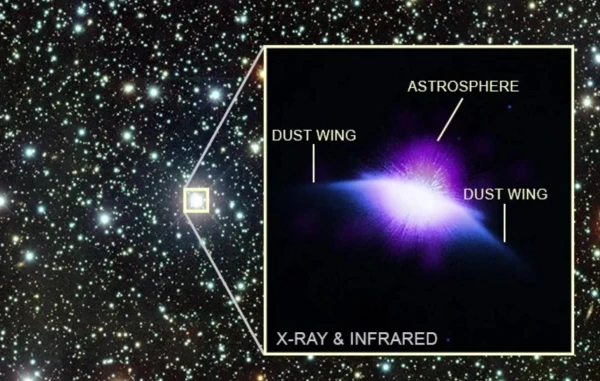
Astronomers have obtained an image of the astrosphere around a Sun-like star for the first time. This observation allowed scientists to see what was happening with our star billions of years ago.
Using NASA's Chandra space X-ray telescope, astronomers have captured a photograph of a young version of the Sun for the first time, that is, a star similar to ours but 4 billion years younger, which creates a protective bubble around itself known as the astrosphere. This is the first image of such an object around a Sun-like young star. Thanks to these observations, astronomers were able to see what was happening with the Sun billions of years ago when it was young. The study is published in The Astrophysical Journal, writes Focus citing Space.
Scientists studied the young star HD 61005, located 120 light-years away from us. It has roughly the same mass and temperature as the Sun. The age of the young star is 100 million years, while the age of the Sun is 4.6 billion years. Astronomers discovered a huge bubble of hot gas surrounding the young star. This bubble, created by the stellar wind (a stream of high-speed charged particles), is known as the astrosphere. It forms when the stellar wind collides with the surrounding interstellar gas and dust. Thus, a protective shell of the stellar system is formed, which protects it from galactic cosmic rays. The Sun, through the solar wind, has created a similar bubble known as the heliosphere. It extends far beyond the planets of the Solar System and protects the Earth from harmful particles from interstellar space.
Astronomers have obtained an image of the astrosphere around a Sun-like star for the first time. Scientists were able to see X-ray emissions around HD 61005, which outline its astrosphere. Its diameter is about 200 times the distance from the Earth to the Sun, which is approximately 30 billion kilometers.
X-ray emissions occur where the fast, dense stellar wind collides with the colder surrounding interstellar gas. When high-speed particles from the stellar wind interact with the colder material in space, they create X-ray emissions.
Scientists found that the stellar wind of HD 61005 is much more powerful than the solar wind. It moves about three times faster and is about 25 times denser than the solar wind. This is due to the young age of the star HD 61005. The powerful stellar wind enhances the formation of the astrosphere and mimics the behavior of the Sun over 4 billion years ago.
Astronomers determined that the interstellar medium surrounding HD 61005 is about a thousand times denser than the current environment of the Sun, which enhances the interaction of the stellar wind with it and increases X-ray emissions.
Data about the astrosphere of the Sun-like star allows us to learn about the shape of the Sun's astrosphere and how it has changed over billions of years as our star evolved and moved through the Milky Way, scientists say.
Astronomers nicknamed the star HD 61005 "Moth" because it is surrounded by a large amount of dust, which, when viewed in infrared light, resembles the shape of moth wings. This dust is leftover from the star's formation, and the "wings" were formed by the star's movement through space.
The study provides new insights into how stellar winds shape planetary environments and may influence the habitability of worlds around other stars.













Leave a comment