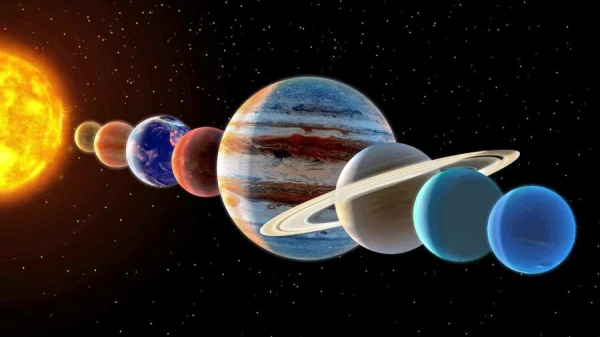
On the evening of February 28, a rare phenomenon will be observed: a great planet parade. Six celestial bodies will line up in the sky.
This visual effect occurs because the orbits of all the planets (including Earth) are approximately in the same plane, known as the plane of the ecliptic. In reality, the planets do not line up in a straight line in space, but at the moment of the "parade," they appear in the same sector relative to the Earth observer, making them visible all at once in a line.
This time, the parade will consist of Mercury, Venus, Jupiter, Saturn, Uranus, and Neptune. In principle, this celestial phenomenon can be observed a day or two before and after February 28.
The best time for observation is half an hour to an hour after sunset. Look towards the west.
Mercury, Venus, Jupiter, and Saturn can be observed with the naked eye, as usual.
Venus is the brightest "star" in the evening sky. Jupiter will also be quite bright, located higher and southeast of Venus. Saturn is less visible and is located closer to Venus, low on the horizon. Mercury is the hardest to see, as it is visible for a very brief time after sunset.
To find Uranus and Neptune in this lineup, a telescope or at least binoculars will be needed.
Overall, this year is rich in planet parades: a small morning parade of Mercury, Mars, Saturn, and Neptune can be seen on April 18, a mini-parade of Mercury, Venus, and Jupiter will take place on June 12, another large parade — this time in the morning — of Mercury, Mars, Jupiter, Saturn, and Neptune will occur on August 12, and finally, on the morning of November 14, Mercury, Venus, Mars, and Jupiter will line up.