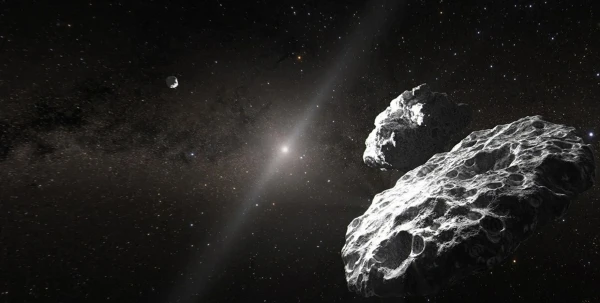
Scientists believe that some large, invisible object is distorting the orbital plane of the Kuiper Belt. The invisible object may be larger than the planet Mercury.
The idea of an invisible planet lurking in the outskirts of the Solar System is far from new. However, the authors of a new study claim that their discovery represents a completely different celestial body, rather than the infamous "Ninth Planet." The scientists have named the unknown object "Planet Y," reports Focus referencing IFL Science.
It may be located beyond the orbit of Neptune, in the Kuiper Belt. This region is filled with thousands of rocky and icy bodies, including Pluto.
Scientists have long observed that some objects in the Kuiper Belt have strange orbits. Researchers hypothesized that these icy bodies are subjected to unexplained gravitational influences from an invisible planet. This hypothetical object is commonly referred to as Planet 9 or Planet X.
However, the authors of the study decided to look for discrepancies in the orbital plane of the Kuiper Belt itself. By tracking the orbits of over 150 Kuiper Belt objects, they determined that the plane of the belt roughly aligns with the plane of the inner Solar System at distances of 50 to 80 astronomical units from the Sun, where one unit represents the distance between the Sun and Earth.
However, at distances from 80 to 200 astronomical units, the study authors observed an orbital distortion that had previously gone unnoticed. After conducting a series of simulations, they concluded that "a planet with a mass between that of Mercury and Earth is the most likely cause of this distortion."
"Such a body differs in both mass and semi-major axis from the various versions of the invisible planet proposed to explain the clustering of apsides in the outer Solar System," the authors of the study write.
Compared to the latter, Planet Y is much less massive and is located closer to the Sun, the authors explain. And although we know little about this object, the researchers state that "such a body could very well have formed in the early stages of the Solar System's history."