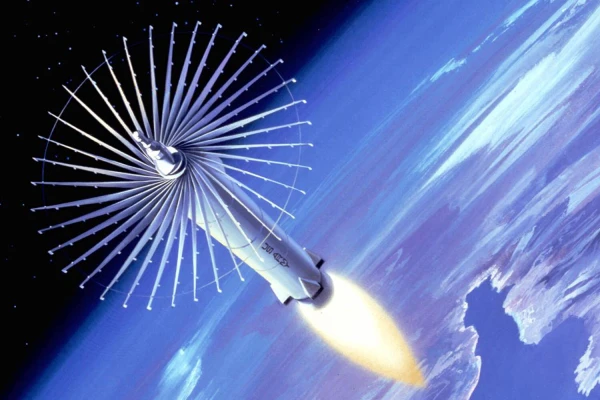
The first victim in the event of a conflict between the USA and China will be Elon Musk's constellation.
In the event of a full-scale war between the USA and China, the question of what to do with satellites in orbit will inevitably arise. Space reconnaissance plays too important a role on the modern battlefield, and Washington and Beijing have hundreds of missiles capable of destroying orbital devices. But if satellites start being shot down one after another, the long-predicted 'Kessler Syndrome' could begin — an avalanche-like chain reaction of destruction of space devices, resulting in humanity being able to forget about flights into orbit for decades.
Depriving the Eye in the Sky
The idea of anti-satellite weapons has existed for about as long as the space age of humanity. In 1959, even before Yuri Gagarin's flight, the Americans conditionally struck their own satellite Explorer VI with the Bold Orion air-launched ballistic missile — it passed 6.4 km from it and would have certainly destroyed the device if it had been armed with a nuclear warhead.
A decade later, the USSR developed a kamikaze spacecraft called the Satellite Killer (ISK) — a massive machine that was guided to its target using radar, approached it, and exploded. Even later, in 1985, the American F-15 fighter achieved the first-ever 'victory' in the air-to-space class by shooting down the decommissioned comet observatory Solwind.
During this time, space interceptors have become much simpler and more convenient, and currently, the USA, China, Russia, India, and Israel have missiles that operate in roughly the same way. Their powerful multi-stage rocket booster launches a small kinetic warhead with a guidance system and a set of engines into space on a ballistic trajectory, which then rams the target device, shattering it into numerous fragments.
Little is known about Russian or Chinese weapons of this class and their deployment, but in the USA, these missiles are already in service under the designation RIM-161 SM-3. Their primary purpose is to intercept ballistic missiles, but there is no fundamental difference between them and satellites.
It is believed that dozens are deployed on ships and ground launchers, with many hundreds of RIM-161 in storage.
Right now, China and the USA are openly preparing for a confrontation with each other. If the conflict escalates into a total war akin to the two previous world wars, the most logical step for both sides would be to attempt to blind the opponent by depriving them of space reconnaissance and communication means. There are relatively soft methods for this: hacking devices, disabling them with lasers or microwaves, blocking communications with electronic warfare means, and several others. However, defenses can be developed against these methods — while there is almost no defense against a ramming projectile.
Starlink — The First Victim
War itself brings countless disasters, the scale and horror of which do not need to be reiterated. But if the conflict reaches orbit, it will, among other casualties, deprive humanity of space for decades, destroying the technological progress that has been regarded as a symbol of progress itself since the mid-20th century.
"When a space device is hit by a kinetic warhead, a cloud of debris is created. The number of these fragments, their size, and precise orbits depend heavily on the design of the device and the interception trajectory, but in any case, they pose a danger to many neighboring orbits," said leading engineer and astronomer Viktor Voropaev, head of the International Network of Optical Telescopes at the Keldysh Institute of Applied Mathematics of the Russian Academy of Sciences.
In the event of a conflict, the expert believes that the primary targets will be objects at altitudes of 400 to 700 kilometers, where military satellites are located. These include optical, radar, and radio reconnaissance satellites.
At the same time, other important devices orbit at these altitudes, including the Hubble telescope, the ISS, and the Chinese Tiangong station.
In 2021, after Russia destroyed its own device, the Tselina-D, during an anti-satellite missile test, the debris cloud put the ISS at risk and forced astronauts to take shelter in spacecraft in case of a collision.
However, the danger comes not only from the destroyed space devices themselves.
"If hundreds of satellites are destroyed in the most densely populated orbits, an avalanche-like chain reaction known as the Kessler Syndrome could begin. Dozens and hundreds of fragments from the downed satellites will turn into space debris, colliding with other devices, shattering them into fragments, and generating new debris. Multi-satellite constellations, like the famous Starlink, are particularly dangerous in this regard," the astronomer explained.
Low Earth orbit is an immense space much larger than the ocean, and the chance of a random collision in it is minimal. However, the satellite internet system of SpaceX and its analogs rely on colossal constellations of many thousands of devices. Right now, there are over nine thousand Starlink satellites in orbit, and in the coming years and decades, more than two million devices could be sent into space — at least, that many applications have been submitted to the International Telecommunication Union.
"Therefore, such satellite constellations could become the primary material for launching an avalanche, simply based on probability theory.
In general, as Americans admit in private conversations, their system for tracking space objects is already struggling with the task.
Starlink has an automatic avoidance system, and just last year, its devices performed over one hundred thousand avoidance maneuvers. If you add to this hundreds of thousands of fragments, which are almost impossible to track — the system will fail almost immediately. They will either not know where to 'blow' the engine to avoid, or they will quickly run out of fuel," the expert explained.
What Will This Lead To?
The Kessler Syndrome is a hypothetical scenario derived from expert assessment. Periodically, studies on this topic emerge — for example, in 2018, a paper by Czech scientists was published, modeling a probable war with massive use of anti-satellite weapons.
According to their forecast, the destruction of 200 satellites will not trigger the Kessler Syndrome. However, they themselves urge not to place too much faith in their calculations and acknowledge the strict limitations of their model. Modern computers cannot predict the trajectories of millions of fragments using celestial mechanics formulas, and therefore scientists are forced to use indirect, statistical methods. In other words, predicting the consequences of such a war can only be done very roughly.
"It can be said with certainty that if hundreds of satellites are shot down during a war, humanity will be able to forget about manned spaceflight for a long time. At least this applies to low Earth orbit, where the ISS is located — the huge station has almost no chance of passing through debris. Perhaps, in a favorable scenario, it might be possible to quickly fly through the debris cloud to reach the Moon or Mars, but that will be at the discretion of those who take such risks and allow the launch," Voropaev said.
Fortunately, at such altitudes, the Earth's atmosphere acts on satellites, causing both devices and debris to gradually slow down and fall.
According to the astronomer, natural cleaning of the orbit from the consequences of a space war will take about 20 years, but the exact timing depends on solar activity cycles and damage parameters.
The war at geostationary orbit deserves separate mention — where, at an altitude of 35,786 kilometers, a satellite can orbit the Earth, remaining above the same point on the equator. RIM-161 cannot reach there, but according to Voropaev, danger may come from another American device.
"In 2022, the Americans began using devices that we jokingly call 'air mothers' — there were such planes in the mid-century that carried fighters, 'aircraft carriers'. They are called ESPA and look like cylinders with about ten slots for CubeSats — miniature satellites. A CubeSat can stay in the 'mother' for months or years without using resources, and at the right moment, it detaches and, using engines, goes on its own flight. They are launched by the US Space Forces, and all missions are classified, but it is known that such CubeSats have approached other devices in geostationary orbit and can be used for reconnaissance. And since they can approach, they can also explode nearby or ram a vulnerable spot on a satellite," the astronomer noted.
However, from the perspective of long-term consequences, the destruction of geostationary satellites is not as dangerous. Firstly, there are fewer of them, and there is neither Starlink nor its analogs there. Secondly, the diameter of the geostationary orbit is over 60,000 kilometers — that is, there is simply more free space there.
But, in any case, the consequences alone in low Earth orbit will be enough to destroy the space industry in its current form. This cannot be unknown to the military and experts in both the USA and China, and therefore there is hope that the parties will come to a formal or tacit pact — not to use kinetic weapons to destroy orbital devices. Such pacts can be adhered to even during the fiercest conflicts — for example, during World War II, Germany did not use chemical weapons, fearing reciprocal actions against itself.
The simplest way to preserve space exploration, of course, would be to completely abandon war — but in the past, such arguments have almost never worked on countries.