
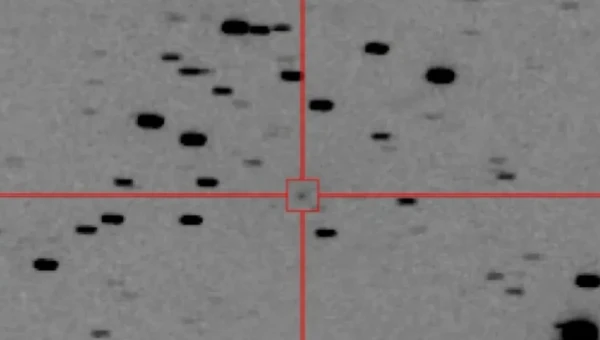
Astronomers have discovered a new comet that may be destroyed during its close encounter with the Sun in early April. But if it survives, it could turn out to be one of the brightest comets in the sky in recent years.
The new comet C/2026 A1 (MAPS), which is currently approaching the Sun, has attracted the attention of astronomers primarily due to its origin. It is believed to belong to a group of comets that sometimes become very bright and are easily visible in the Earth's sky. C/2026 A1 (MAPS) could become one of the brightest comets in recent years, and it may even be possible to see it with the naked eye in early April if it survives its encounter with the Sun, writes Focus citing Space.
The new comet C/2026 A1 (MAPS) was discovered on January 13, 2026, using a telescope at the AMACS1 observatory in Chile. Initially, the comet appeared very dim, but scientists believe its brightness will increase as it approaches the Sun.
Astronomers have determined that C/2026 A1 (MAPS) belongs to a group of comets known as Kreutz sungrazers. It is believed that thousands of such comets of various sizes are currently orbiting the Sun, which, a couple of thousand years ago, were part of one massive comet that broke apart. Many of the Kreutz comets vaporize under the influence of radiation and heat from our star when they come close to the Sun. However, some survive and continue their journey through the Solar System.
The Kreutz sungrazers group includes several comets that were particularly bright and could be observed even with the naked eye from Earth in the past. Not only at night but also during the day.
For example, one such comet was C/1965 S1 (Ikeya-Seki), which in 1965 became as bright as a full moon and was easily visible to the naked eye not only at night but also during the day. In 2011, C/2011 W3 (Lovejoy) was as bright as Venus.
Astronomers believe that the new comet C/2026 A1 (MAPS) could become just as bright and may be visible to the naked eye in early April after sunset. It may become so bright that it could even be seen during the day. However, scientists cannot say for sure whether this comet will survive its close encounter with the Sun, which will occur on April 4. On that day, comet C/2026 A1 (MAPS) will be at a distance of about 120,000 km from the Sun, which is very close by cosmic standards. The immense temperature and radiation from the star could cause this comet to break apart, and we may never see it again. But if it survives the encounter with the Sun, we may expect an impressive spectacle for about a week after April 4.
In any case, comet C/2026 A1 (MAPS) has already made history. It was discovered at a distance of about 300 million km from the Sun, meaning it was farther from the Sun than any previously discovered sungrazing comets.
Astronomers believe that by mid-March, it will be possible to understand how the comet will behave in early April and whether it will survive its close encounter with the Sun. It will also be clearer how bright the comet could become in April if it survives.
Even if C/2026 A1 (MAPS) does not put on a bright display in the Earth's sky, photographs of it will still be obtained from various spacecraft as it approaches the Sun at its closest distance.













Leave a comment