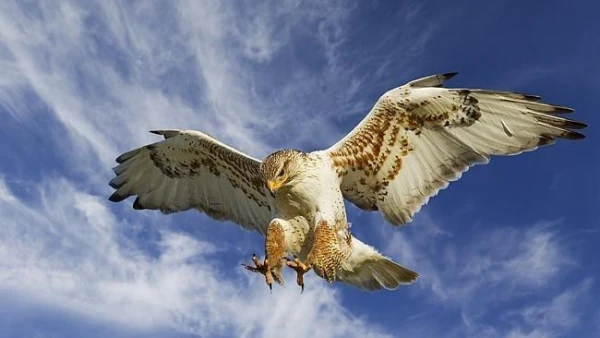
Beijing's military is particularly focused on swarms of drones capable of taking down prey and robots capable of pursuing enemies.
China is placing significant emphasis on the use of AI for deploying swarms of drones, robotic dogs, and other autonomous systems. The idea is that they will be able to suppress enemies or create an impenetrable defense against threats with minimal human involvement. To model collisions between drone swarms in real-time, Chinese engineers are looking to nature for inspiration, studying animal behavior.
As reported by The Wall Street Journal, in one project, observing how hawks select their prey, they trained defensive drones to identify and destroy the most vulnerable enemy aircraft. On the other hand, attacking drones were trained to evade the hawk-trained defenders based on the behavior of pigeons. In a “five-on-five” test, the hawks destroyed all the pigeons in 5.3 seconds.
This research earned the engineers a patent in April 2024 – one of hundreds of patents issued in recent years to Chinese defense companies and military-related universities for advancements in swarm intelligence.
Since the beginning of 2022, Chinese defense contractors, military institutes, and military-related universities have published at least 930 patent applications related to swarm intelligence. In the U.S., only about 60 such patents have been published during the same period, with at least 10 of them filed by Chinese organizations.
The era of AI will usher in a new style of warfare, “based on algorithms, with unmanned systems as the main combat force and swarm operations as the primary mode of fighting,” a group of Chinese military theorists wrote in October 2024. They compared the potential of AI in transforming the army to gunpowder – a technology invented in China but, as many in China believe, more effectively used as a weapon by other countries.
A New Approach
Other works by Chinese researchers use a similar approach, adjusting algorithms based on the behavior of ants, sheep, coyotes, and whales to achieve theoretical improvements in the cooperation capabilities of unmanned systems.
Speaking at a drone conference in Beijing in July, Professor Duan Haibin, who led the modeling of the hawk and pigeon swarm, said that Chinese researchers are also trying to mimic the eyes of eagles and fruit flies in search of solutions to drone perception problems.
In September of last year, China showcased a pack of “robot wolves” at a military parade – enhanced, armed versions of robotic dogs. In an interview with state media, the manufacturer of these devices, the state-owned China South Industries Group, stated that the company is working on ways to combine wolf packs with aerial swarms to create a “new model of effective joint combat.”
As drones become cheaper and more sophisticated, science fiction visions of armies of robots with artificial intelligence clashing on the battlefield are drawing closer to reality. A recent surge in research in drone intelligence is leading to the emergence of many new or updated algorithms, many of which are modeled on the behavior of animal groups, theoretically setting rules of action and reaction for large numbers of drones to accomplish missions.
The main challenge is getting these algorithms to work on real drones in realistic combat scenarios, believes Justin Bradley, an aerospace engineering expert from North Carolina State University specializing in autonomous systems.