
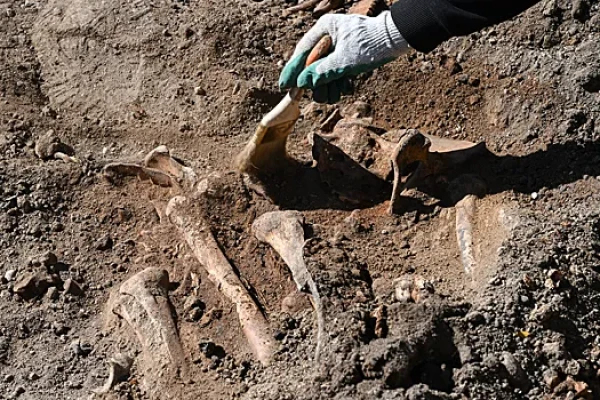
Around 12,000 people were buried in 11 large mass graves.
Archaeologists from Leipzig University have discovered a large burial site from the 14th century in central Germany, near the medieval village of Neuses. The researchers believe this may be one of the mass graves of victims of the plague epidemic known as the 'Black Death,' according to the scientific journal PLOS One.
The study began with an examination of historical chronicles from the city of Erfurt, which state that in 1350, during the peak of the epidemic in the region, around 12,000 people were buried in 11 large mass graves outside the city walls.
Modern methods such as ground-penetrating radar scanning and drilling allowed for the detection of a structure underground with mixed deposits and fragments of human bones. Radiocarbon dating confirmed that the remains date back to the 14th century.
The head of the study, Michael Hein, stated that the data obtained highly likely indicates the discovery of one of the burials described in the Erfurt chronicles. The find provides researchers with a rare opportunity to study the demographic and social consequences of one of the most terrible pandemics in human history.
The 14th-century plague in Germany, part of the 'Black Death,' was a catastrophic pandemic caused by the bacterium Yersinia pestis, which came from Asia and reached Germany via trade routes in 1349, causing mass mortality, social upheaval, a rise in fanaticism and religious intolerance, as well as colossal demographic and economic changes. The population losses were enormous, cities were depopulated, and the consequences were felt for centuries.















Leave a comment