
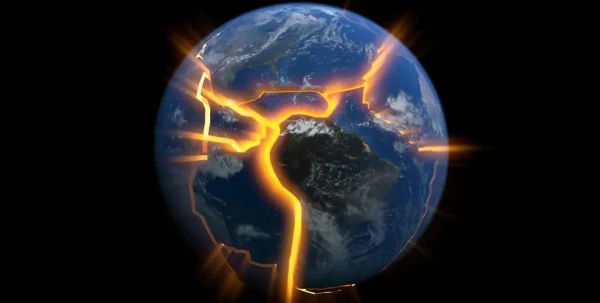
Throughout its history, our planet has experienced sharp climate shifts, oscillating between cold "glacial" and warm "greenhouse" periods. Scientists believe they have found the mechanism responsible for this.
Researchers have long linked natural climate changes on Earth to fluctuations in carbon dioxide concentrations in the atmosphere. However, new studies indicate that the source of this carbon and the driving forces behind it are much more complex than previously thought, writes Science Alert.
In fact, the movement of tectonic plates on the surface of our planet plays an important role in the climate that has been previously underestimated. Carbon emerges not only where tectonic plates converge but also in places where they diverge — these may even be more significant.
In a new study, scientists from the University of Melbourne and the University of Sydney shed light on how exactly plate tectonics has contributed to the formation of Earth's global climate over the past 540 million years.
Earth's Carbon Cycle
At the boundaries where tectonic plates converge, chains of volcanoes, also known as volcanic arcs, are formed. The melting associated with these volcanoes releases carbon that has been locked in rocks for millennia, bringing it to the surface of the planet.
It was previously thought that these volcanic arcs were the main sources of carbon dioxide emissions into the Earth's atmosphere. However, the results of the new study by scientists refute this claim. On the contrary, the researchers believe that mid-ocean ridges and continental rifts — places where tectonic plates diverge — have played a much more significant role in managing Earth's carbon cycle.
The fact is that the Earth's oceans absorb vast amounts of carbon dioxide from the atmosphere. They also store a large portion of it in carbon-rich rocks on the ocean floor. Over thousands of years, this process can create hundreds of meters of carbon-rich deposits on the ocean floor.
As these rocks move across the planet under the influence of tectonic plates, they can cross subduction zones, releasing the trapped carbon dioxide back into Earth's atmosphere. It should be noted that this process is known as the "deep carbon cycle."
A Process Hidden in the Earth's Depths
In the new work, scientists used computer models to reconstruct the movement of carbon stored in tectonic plates. As a result, they were able to predict major greenhouse and glacial climate periods on Earth over the past 540 million years.
Data indicate that during greenhouse periods, more carbon was released than was retained in carbon-containing rocks. On the other hand, during glacial periods, the oceans absorbed more carbon, which reduced carbon dioxide levels in the atmosphere and caused cooling.
The results of the new study offer a new perspective on how Earth's tectonic processes have shaped and will shape the planet's climate in the future. The data also suggest that the planet's climate is determined not only by atmospheric carbon. Instead, the climate is influenced by a complex balance between carbon emissions from the Earth's surface and how it is retained in ocean floor sediments.














Leave a comment