For an advanced extraterrestrial civilization, the simplest way to undertake high-speed interstellar travel may be hitchhiking on a natural object, Focus reports.
In the last decade, astronomers have discovered three interstellar objects, the largest and fastest of which is comet 3I/ATLAS. Harvard astrophysicist Avi Loeb believes that objects like 3I/ATLAS, which are over a kilometer in size and travel at speeds exceeding 60 kilometers per second, could serve as vehicles for interstellar travel. In other words, an extraterrestrial civilization could use a comet to hide a spacecraft inside it for exploring other parts of the Milky Way, Medium reports.
According to Loeb, the SOHO spacecraft detected a massive hydrogen outburst from 3I/ATLAS, indicating the release of 13.5 million tons of water over a month of observations. If an extraterrestrial civilization is hitchhiking on a water-rich object like 3I/ATLAS, it allows for the use of electrolysis to split water molecules into their constituent hydrogen and oxygen, which serve as effective rocket fuel. The engine system could use this fuel to move to desired destinations, such as the orbital plane of planetary systems. It is possible that SOHO detected part of this hydrogen fuel.
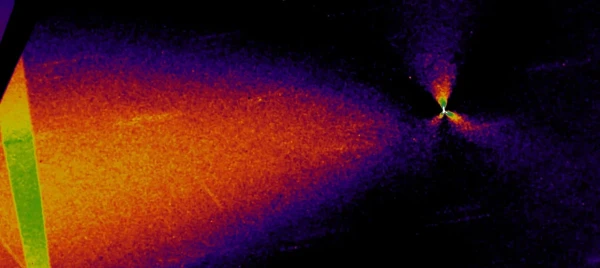
If the interstellar object conceals a spacecraft inside, it could explain anomalies such as the alignment of the trajectory of 3I/ATLAS with the orbital plane of the Solar System's planets at 5 degrees, the alignment of the rotation axis with the direction of the Sun at great distances, the symmetrical jet system of 3I/ATLAS, and the anomalously high nickel-to-iron ratio in the composition of the comet, Loeb says.
Embedding a technological object inside a comet has the advantage of disguising the equipment as a natural object, meaning that any observers would not be able to detect it.
If a spacecraft were sent to study comet 3I/ATLAS from a close distance, it could potentially discover the energy source needed to convert water into hydrogen and oxygen fuel, as well as to power the spacecraft inside the comet, Loeb states.
The detection of an interstellar apparatus of this type could encourage humanity to utilize natural interstellar objects for the same purpose.
According to Loeb, if we decided to hitchhike to other stars, we would first need to identify a suitable interstellar object. Then, we would need to deliver a payload, including an energy source and technological equipment, along a trajectory that intersects the path of the interstellar object, at a sufficiently low impact speed to avoid damaging the payload. The equipment would also need to be equipped with artificial intelligence so that the apparatus could operate in a fully autonomous mode.
Loeb says that in light of this perspective, it is reasonable to continue monitoring comet 3I/ATLAS in the coming months, including after its close passage near Jupiter on March 16, 2026.