
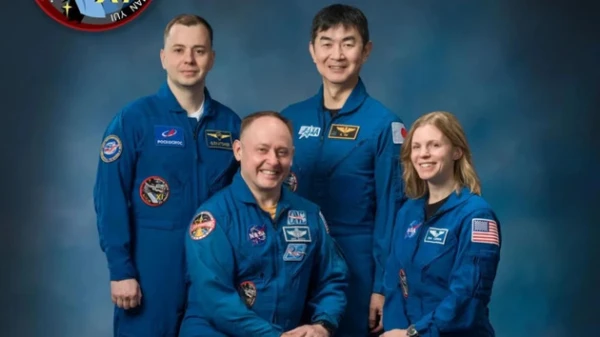
Crew-11 members aboard the International Space Station are set to return to Earth early on Wednesday, January 15, NASA reports. This decision was made due to health issues experienced by one of the mission members.
“NASA and SpaceX plan to undock the Crew-11 mission from the International Space Station no earlier than 5:00 PM Eastern Standard Time [1:00 AM the next day Moscow time, 10:00 PM the same day Greenwich Mean Time — Ed.] on January 14, with splashdown off the coast of California scheduled for early morning on January 15, depending on weather conditions and the readiness of the recovery team,” the ISS said in a post on social media platform X.
The timing may change depending on the progress of real-time operations, NASA noted.
The Crew-11 crew includes commander Zena Cardman, pilot Michael Fink, Japanese astronaut Koichi Wakata, and Russian cosmonaut Oleg Platonov.
It is not specified who exactly has health issues and what the illness is.
If the entire Crew-11 returns to Earth together, American Christopher Williams and Russians Sergey Kud-Sverchkov and Sergey Mikayev from the Soyuz MS-28 crew will remain on the ISS.
Crew-11 was launched to the ISS in August 2025. Typically, the mission lasts six months, and the return was scheduled for the second half of February, when Crew-12 is expected to deliver four other astronauts to replace them.
The news that the crew would have to return early became known on January 8.
“Yesterday, January 7, one of the crew members on board experienced a medical situation and is currently in stable condition,” NASA Administrator Jared Isaacman stated at a press conference. He added that he made this decision after consulting with Chief Medical Officer Dr. James Polk and agency leadership.
The space agency has a privacy policy under which NASA does not specify which crew member is involved and does not provide any details about health issues.
However, James Polk assured that the astronaut's condition was not caused by an injury or working conditions on the ISS or in space.
According to Polk, NASA is returning the crew to Earth for medical reasons for the first time in the agency's history, which has been operational for over 65 years.
The ISS has basic medical equipment, necessary supplies, and communication systems that allow doctors on Earth to communicate confidentially with astronauts in space, assess their condition, and recommend treatment. However, it is not possible to place all the medical equipment needed for a complete health diagnosis on the space station.
What is known from the conversations
As CBS News, the American partner of the BBC, reports, during a brief radio communication session “space to Earth,” Koichi Wakata requested a medical consultation.
The flight control center in Houston responded that a consultation using a secure radio channel would be organized shortly.
After that, Wakata inquired whether a space medicine specialist was available and if the flight operators had a direct video feed from the station.
He used the terms “crew surgeon” and “flight surgeon,” but the word surgeon in this context does not necessarily mean a surgeon. “Flight surgeon” is a standard term in aviation and space exploration, referring to a doctor who has received specialized training in aviation and space medicine and is responsible for the health of pilots and astronauts.
No further radio communications were heard. Typically, audio broadcasts of conversations with the International Space Station are streamed live on YouTube 24/7, but it was suspended without explanation.
Due to the situation, a planned spacewalk had to be canceled at the last minute, and the reduction in the number of people on the ISS will delay some experiments and maintenance work until the arrival of the new crew.
The launch of the next mission — Crew-12 — was scheduled no earlier than February 15.
“The space station is a large and complex engineering structure designed to operate with a certain minimum number of crew members,” noted Simeon Barber, a space specialist from the Open University, in a comment to the BBC.
“If Crew-11 returns early, the remaining crew will have to reduce some experimental work and focus mainly on routine tasks and maintaining the station's functionality while waiting for the full crew to be restored.”
NASA Deputy Administrator Amit Kshatriya assured at the press conference that the only remaining American astronaut on the station would handle all necessary tasks.
“Chris is trained to perform all tasks aboard the station that may be assigned to him,” he stated, adding that thousands of specialists would monitor his work.
According to Kshatriya, if necessary, assistance could also be provided by Russian cosmonauts who are qualified to work with American systems.











Leave a comment